Munja-Chaekgeori Screen (Character-Books Screen) (early 1900s): Art, History and Details
Munja-Chaekgeori Screen (Character-Books Screen) at the Cleveland Museum of Art: early 1900s, Eight-panel folding screen, ink on paper. Explore the work's context, creator attribution and collection history.
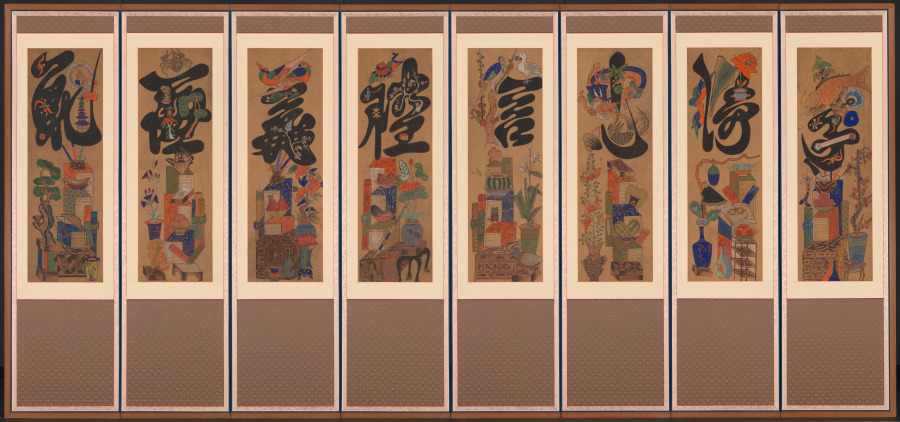
Munja-Chaekgeori Screen (Character-Books Screen) (early 1900s) is in the Cleveland Museum of Art collection.
The work and its context
The museum's open-access catalogue describes the work:
This folding screen is a whimsical harmony of two different subjects: chaekgeori, or books and things; and munja, or characters. The lower section of each panel depicts the imagery of things, including books, decorative arts, and utilitarian objects. The upper portion of each panel bears a classical Chinese character. Read from far right to left, the eight characters refer to the values of Confucian teachings of the Joseon dynasty: filial piety, brotherly love, loyalty, trust, propriety, righteousness, modesty, and humility. While these two pictorial genres are harmoniously conjoined on the same picture plane, two sharply contrasting world views—urban consumerism and traditional Confucian ethics that despise materialism—compete with one another.
Object facts
- Title: Munja-Chaekgeori Screen (Character-Books Screen)
- Date: early 1900s
- Culture: Korea, Joseon dynasty (1392–1910)
- Type: Painting
- Technique: Eight-panel folding screen, ink on paper
- Dimensions: Overall: 150.5 x 330.2 cm (59 1/4 x 130 in.); Painting only: 85.1 x 27.3 cm (33 1/2 x 10 3/4 in.)
- Collection: ASIAN - Folding screen
- Department: Korean Art
- Accession number: 2017.6
A detail from the museum
The eight Korean characters each mean filial piety, brotherly love, loyalty, trust, propriety, righteousness or justice, modesty or integrity, and humility or the feeling of shame.
Collection credit
Severance and Greta Millikin Purchase Fund
Further reading listed by the museum
- Yi, Young-joo. "Character Painting in the Late Joseon Dynasty [조선후기의 孝悌文字圖]." Misulsa nondan (2007): 231–260.
- Chung, Byong-mo. Revolution of Anonymous Painters: Folk Painting [무명 화가들 의 반란, 민화]. Seoul: Dahal Media, 2011.
- Treasures from Korea: Arts and Culture of the Joseon Dynasty, 1392-1910. Philadelphia: Philadelphia Museum of Art, 2014.
View the collection record
See the museum's photographs and full catalogue entry. Catalogue text is reproduced from the Cleveland Museum of Art's open-access data, with HTML formatting removed. This object and its supplied image are designated CC0.
Sources
More in Lifestyle
Keep reading