Naga-enthroned Buddha (serpent hoods) (1100–1150): Art, History and Details
Naga-enthroned Buddha (serpent hoods) at the Cleveland Museum of Art: 1100–1150, bronze. Explore the work's context, creator attribution and collection history.
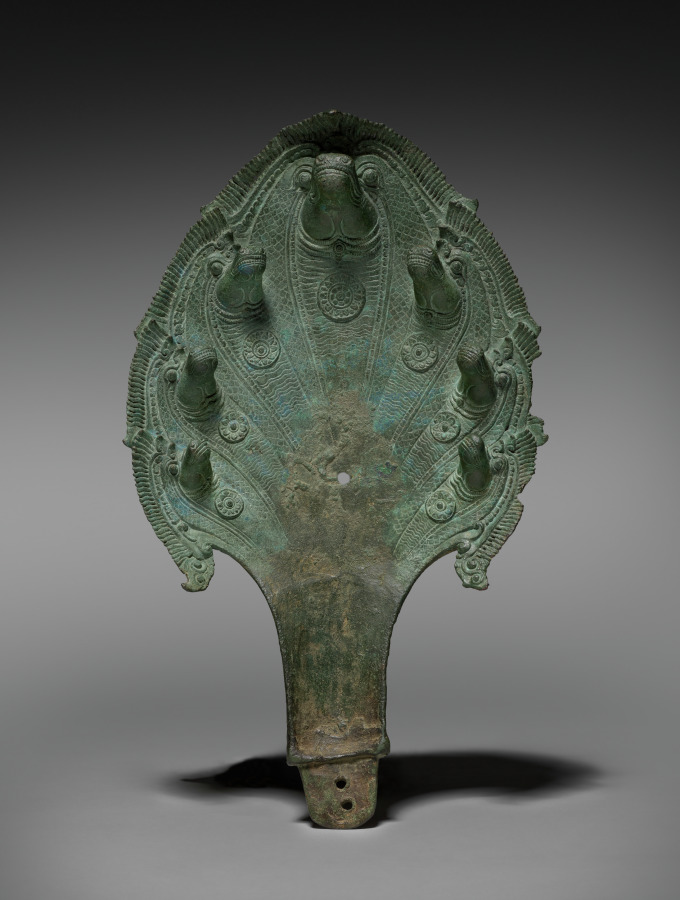
Naga-enthroned Buddha (serpent hoods) (1100–1150) is in the Cleveland Museum of Art collection.
The work and its context
The museum's open-access catalogue describes the work:
Jayavarman VII, who built the great royal temple at Banteay Chhmar, linked himself with the image of the Buddha seated on a serpent, or naga, as the divine form under which he would be honored. During his reign, the naga-enthroned Buddha became a ubiquitous image for veneration, often set up together with Lokeshvara, who was associated with his father, and Prajnaparamita, the form under which his deceased mother was honored. Lokeshvara is the powerful enlightened being of compassion, while Prajnaparmita is the goddess who personifies wisdom. King Jayavarman VII, therefore, presented himself as the enlightened Buddha, the product of the union of Compassion and Wisdom, supported and glorified by the naga, which refers to the Khmer people. Images of the naga-enthroned Buddha have been found at Banteay Chhmar, both in architectural relief sculpture and as icons in the round. After the death of Jayavarman VII, followers of other forms of Buddhism (for example, Theravada) that became prevalent in Cambodia changed the meaning of the naga-enthroned Buddha and reinterpreted the image to refer to a scene from the historical Buddha’s life story in which a serpent protected him from a flood. The crowned and bejeweled aspect of this Buddha, though, indicates that it is another kind of transcendent figure. In his lap his hands are in a posture of meditation, holding what appears to be an offering of ceremonial rice referring to the hope that he will ensure the prosperity of the land.
Object facts
- Title: Naga-enthroned Buddha (serpent hoods)
- Date: 1100–1150
- Culture: Cambodia, Angkor, Angkor Wat Period, 12th century
- Type: Sculpture
- Technique: bronze
- Dimensions: Overall: 58.4 x 28 cm (23 x 11 in.)
- Collection: Cambodian Art
- Department: Indian and Southeast Asian Art
- Accession number: 1963.263.c
Collection credit
John L. Severance Fund
Further reading listed by the museum
- "Oriental Art Recently Acquired by American Museums, 1963." Archives of the Chinese Art Society of America 18 (1964): pp. 69-91.
- Marcus, Margaret F. “Buddha Sheltered by Mucalinda.” The Bulletin of the Cleveland Museum of Art 52, no. 7 (1965): 185–93.
- The Cleveland Museum of Art. Handbook of the Cleveland Museum of Art/1966. Cleveland, OH: The Cleveland Museum of Art, 1966.
View the collection record
See the museum's photographs and full catalogue entry. Catalogue text is reproduced from the Cleveland Museum of Art's open-access data, with HTML formatting removed. This object and its supplied image are designated CC0.
Sources
More in Lifestyle
Keep reading