Naga (Serpent Divinity) (300s CE): Art, History and Details
Naga (Serpent Divinity) at the Cleveland Museum of Art: 300s CE, sandstone. Explore the work's context, creator attribution and collection history.
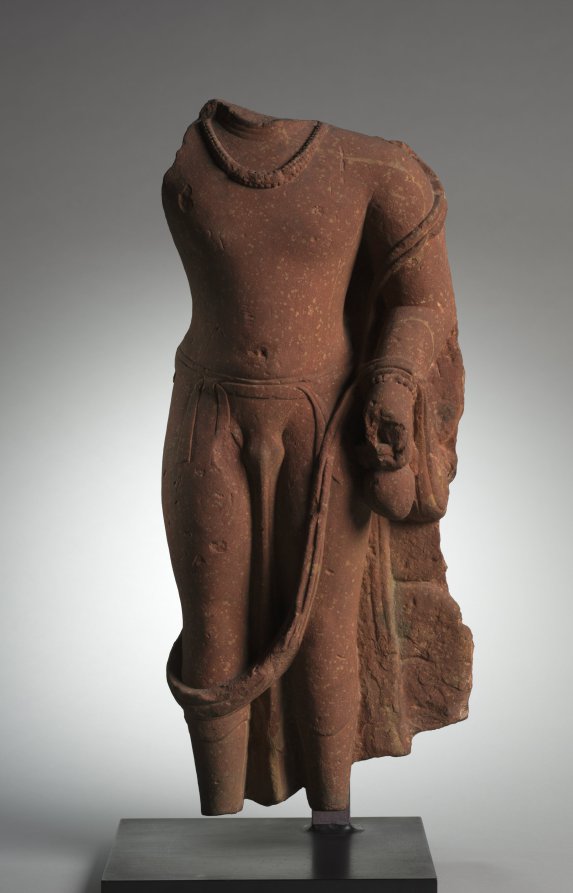
Naga (Serpent Divinity) (300s CE) is in the Cleveland Museum of Art collection.
The work and its context
The museum's open-access catalogue describes the work:
The coils of a serpent's body and the bottle of water in his hand confirm the identity of this figure as a water serpent divinity called a naga. Nagas continue to be important divinities in local piety, for they control the forces of water, essential for prosperity.
Object facts
- Title: Naga (Serpent Divinity)
- Date: 300s CE
- Culture: India, Mathura, Kushan period
- Type: Sculpture
- Technique: sandstone
- Dimensions: Overall: 67.3 cm (26 1/2 in.)
- Collection: Indian Art - Kushan, Mathura
- Department: Indian and Southeast Asian Art
- Accession number: 1943.661
Collection credit
Purchase from the J. H. Wade Fund
Further reading listed by the museum
- Codrington, Kenneth de Burgh, and William Rothenstein. Ancient India from the Earliest Times to the Guptas with Notes on the Architecture and Sculpture of the Mediæval Period. London: E. Benn, Limited, 1926.
- Hollis, Howard. “Three Indian Buddhist Sculptures.” The Bulletin of the Cleveland Museum of Art, vol. 31, no. 3, 1944, pp. 33–37.
- The Cleveland Museum of Art. The Cleveland Museum of Art Handbook. Cleveland, OH: The Cleveland Museum of Art, 1958.
View the collection record
See the museum's photographs and full catalogue entry. Catalogue text is reproduced from the Cleveland Museum of Art's open-access data, with HTML formatting removed. This object and its supplied image are designated CC0.
Sources
More in Lifestyle
Keep reading