Nagarjuna (c. 150–250 CE) with a Buddhist Master (c. 1300s): Art, History and Details
Nagarjuna (c. 150–250 CE) with a Buddhist Master at the Cleveland Museum of Art: c. 1300s, gum tempera on sized cotton. Explore the work's context, creator attribution and collection history.
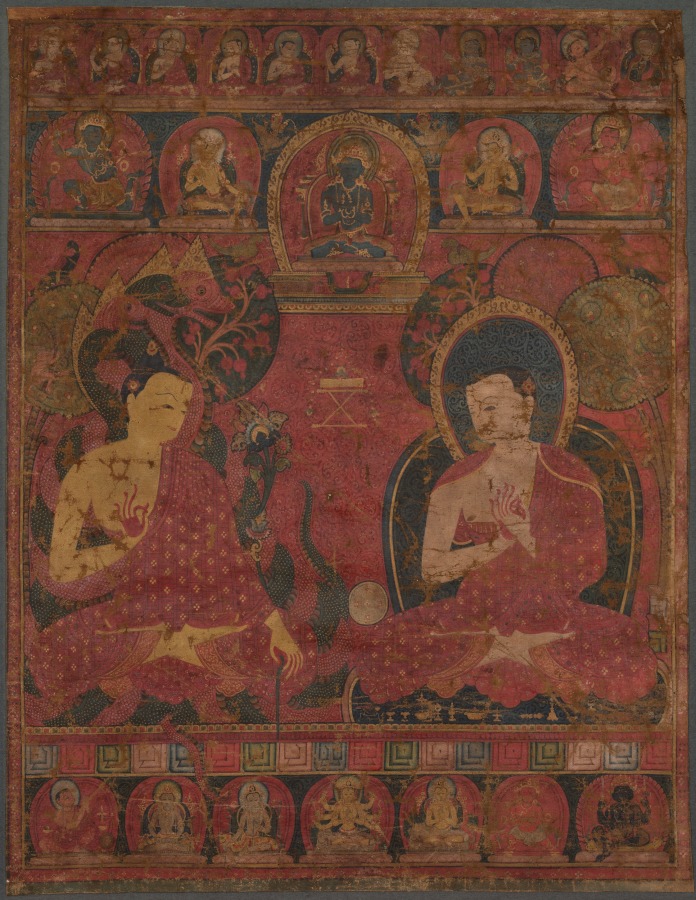
Nagarjuna (c. 150–250 CE) with a Buddhist Master (c. 1300s) is in the Cleveland Museum of Art collection.
The work and its context
The museum's open-access catalogue describes the work:
Nagarjuna, the Buddhist philosopher from southern India, sits on his eponymous red and black serpents, or naga. His interlocutor may be his disciple Aryadeva. A volume of the Perfection of Wisdom, honored with flowers, is on a golden bookstand between their heads. The figures sit beneath flowering and fruiting trees with peacocks and parrots, evoking the landscape of India. Lineage masters of the Sakya order of Buddhism are aligned in the top row, beginning with Virupa at the upper right. The monk who was the donor of this painting is in the lower left corner.
Object facts
- Title: Nagarjuna (c. 150–250 CE) with a Buddhist Master
- Date: c. 1300s
- Culture: Nepal
- Type: Painting
- Technique: gum tempera on sized cotton
- Dimensions: Overall: 57.8 x 45.1 cm (22 3/4 x 17 3/4 in.)
- Collection: Nepalese Art
- Department: Indian and Southeast Asian Art
- Accession number: 1985.186
A detail from the museum
The Bodhisattva of Wisdom, who was Nagarjuna's teacher, is in the central 8-armed figure in the bottom row.
Collection credit
Gift of George P. Bickford
View the collection record
See the museum's photographs and full catalogue entry. Catalogue text is reproduced from the Cleveland Museum of Art's open-access data, with HTML formatting removed. This object and its supplied image are designated CC0.
Sources
More in Lifestyle
Keep reading