Nataraja, Shiva as the Lord of Dance (1000s): Art, History and Details
Nataraja, Shiva as the Lord of Dance at the Cleveland Museum of Art: 1000s, Bronze. Explore the work's context, creator attribution and collection history.
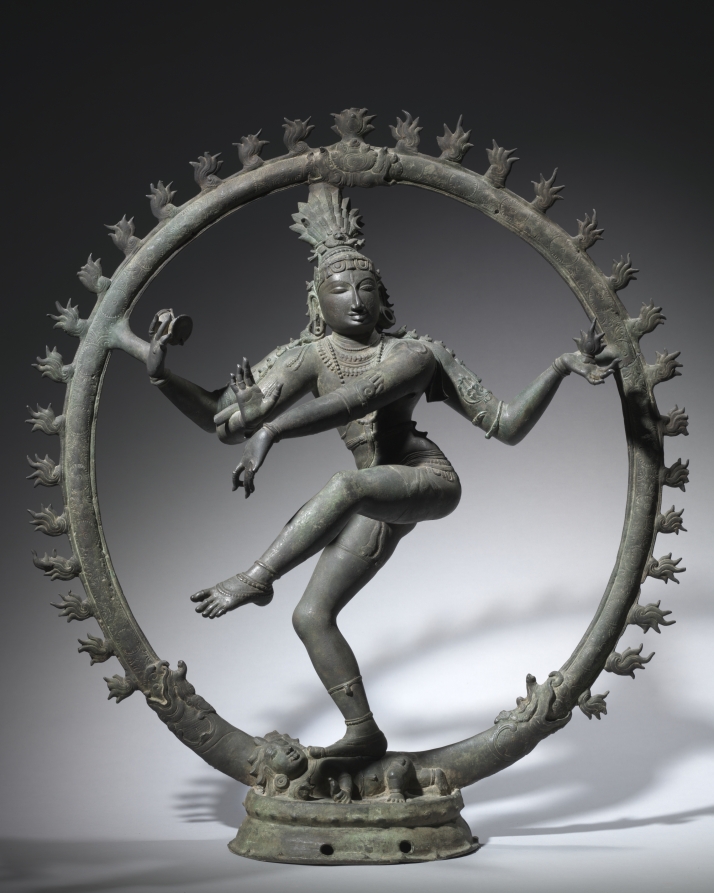
Nataraja, Shiva as the Lord of Dance (1000s) is in the Cleveland Museum of Art collection.
The work and its context
The museum's open-access catalogue describes the work:
One of the most celebrated sculptural forms in the history of Indian art, this elegant and dynamic figure embodies some of Hinduism’s most fundamental tenets. According to Hindu thought, time is cyclical; the world is created, maintained, preserved for a time, then destroyed, only to be created again an infinite number of times. For those Hindus who view Shiva to be the all-powerful creator divinity, he is responsible for both creation and destruction. The ring of fire and the tongue of flame he holds in his left hand refer to destruction, and the drum in his raised right hand refers to the relentless beat of time as it moves inevitably forward. His lower right hand, held up with the palm facing out, signals to his devotees not to be afraid of the impending destruction; they can be liberated from the cycles of birth and death through devotion to him, which he indicates by pointing to his upraised foot. With every step in his dance, he lands on a dwarfish figure personifying ignorance.
Object facts
- Title: Nataraja, Shiva as the Lord of Dance
- Date: 1000s
- Culture: South India, Tamil Nadu, Chola period (900–1200s)
- Type: Sculpture
- Technique: Bronze
- Dimensions: Overall: 113 x 102 x 30 cm (44 1/2 x 40 3/16 x 11 13/16 in.); Base: 35 x 24 cm (13 3/4 x 9 7/16 in.)
- Collection: Indian Art
- Department: Indian and Southeast Asian Art
- Accession number: 1930.331
A detail from the museum
The trampled figure holds a serpent in his left hand and with his right points up to Shiva.
Collection credit
Purchase from the J. H. Wade Fund
Further reading listed by the museum
- Hollis, Howard Conley. “Nataraja, Lord of the Dance.” The Bulletin of the Cleveland Museum of Art 17, no. 8 (October 1930): 148–151.
- The Cleveland Museum of Art. The Cleveland Museum of Art Handbook. Cleveland, OH: The Cleveland Museum of Art, 1958.
- Master Bronzes of India: The Art Institute of Chicago ... [et al]. Chicago: The Art Institute of Chicago, 1965.
View the collection record
See the museum's photographs and full catalogue entry. Catalogue text is reproduced from the Cleveland Museum of Art's open-access data, with HTML formatting removed. This object and its supplied image are designated CC0.
Sources
More in Lifestyle
Keep reading