Nave Nave Fenua (Fragrant Isle) (1893–94): Art, History and Details
Nave Nave Fenua (Fragrant Isle) at the Cleveland Museum of Art: 1893–94, color woodcut. Explore the work's context, creator attribution and collection history.
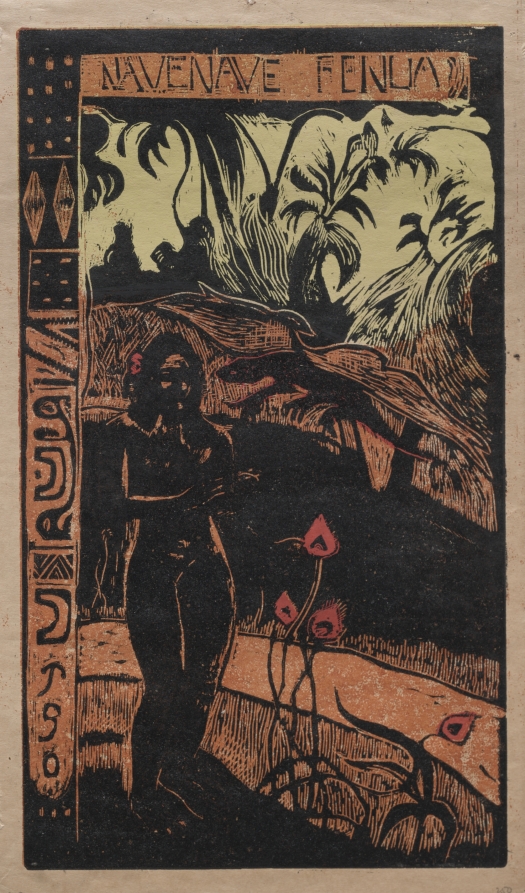
Nave Nave Fenua (Fragrant Isle) (1893–94) is in the Cleveland Museum of Art collection. The museum's creator attribution is Paul Gauguin (French, 1848–1903).
The work and its context
The museum's open-access catalogue describes the work:
In 1891 Paul Gauguin traveled to Tahiti, seeking a more authentic style of art making than the conservatism he rejected in Western culture. After returning to Paris in 1893, he began working on Noa Noa, an illustrated book that explained and illustrated his experiences abroad. Although the project was never completed, this print is one of its illustrations. Gauguin depicted a lush landscape by chiseling roughly into a woodblock, a technique meant to suggest relief sculpture he viewed in Tahiti.
Object facts
- Title: Nave Nave Fenua (Fragrant Isle)
- Date: 1893–94
- Creator attribution: Paul Gauguin (French, 1848–1903)
- Culture: France, 19th century
- Type: Print
- Technique: color woodcut
- Dimensions: Sheet: 38.5 x 22.8 cm (15 3/16 x 9 in.); Platemark: 35.7 x 20.5 cm (14 1/16 x 8 1/16 in.)
- Collection: PR - Woodcut
- Department: Prints
- Accession number: 1933.444
A detail from the museum
Paul Gauguin printed the woodblocks for Noa Noa using a variety of inks and papers.
Collection credit
Gift of The Print Club of Cleveland
Further reading listed by the museum
- Francis, Henry. "A Woodcut by Gauguin." The Bulletin of the Cleveland Museum of Art 21, no. 6 (June 1934): 96-98.
- Broude, Norma. Gauguin's Challenge: New Perspectives After Postmodernism. New York : Bloomsbury Visual Arts, 2018.
View the collection record
See the museum's photographs and full catalogue entry. Catalogue text is reproduced from the Cleveland Museum of Art's open-access data, with HTML formatting removed. This object and its supplied image are designated CC0.
Sources
More in Lifestyle
Keep reading