Night Rain at the Azuma Shrine (from the series Eight Views of the Environs of Edo) (mid-1830s): Art, History and Details
Night Rain at the Azuma Shrine (from the series Eight Views of the Environs of Edo) at the Cleveland Museum of Art: mid-1830s, color woodblock print. Explore the work's context, creator attribution and collection history.
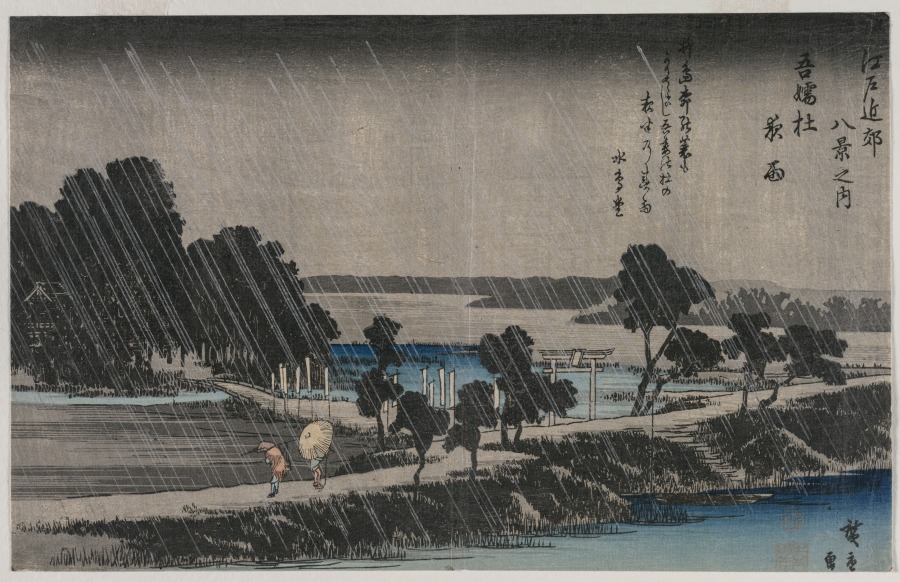
Night Rain at the Azuma Shrine (from the series Eight Views of the Environs of Edo) (mid-1830s) is in the Cleveland Museum of Art collection. The museum's creator attribution is Utagawa Hiroshige (Japanese, 1797–1858).
The work and its context
The museum's open-access catalogue describes the work:
Here Hiroshige reinterprets the traditional Chinese poetic and artistic theme of Eight Views of Xiaoxiang, a scenic region in southeast China. Inspired by “rain at night on the Xiaoxiang,” Hiroshige instead places travelers near Azuma Jinja Shrine in an Edo (present-day Tokyo) suburb. Synthetic blue pigment, imported from the West and wildly popular in the early 1800s, adds vibrancy to the muted landscape. Thin, ruler-straight diagonal lines of white ink evoke the driving rain.
Object facts
- Title: Night Rain at the Azuma Shrine (from the series Eight Views of the Environs of Edo)
- Date: mid-1830s
- Creator attribution: Utagawa Hiroshige (Japanese, 1797–1858)
- Culture: Japan, Edo period (1615–1868)
- Type: Print
- Technique: color woodblock print
- Dimensions: Sheet: 21.6 x 34.4 cm (8 1/2 x 13 9/16 in.)
- Collection: Japanese Art
- Department: Japanese Art
- Accession number: 1942.145
Collection credit
Gift of Mrs. Henry S. Upson
Further reading listed by the museum
- Hollis, Howard. "Upson Gift to the Oriental Department." The Bulletin of the Cleveland Museum of Art 30, no. 6 (June 1943): 100–101.
View the collection record
See the museum's photographs and full catalogue entry. Catalogue text is reproduced from the Cleveland Museum of Art's open-access data, with HTML formatting removed. This object and its supplied image are designated CC0.
Sources
More in Lifestyle
Keep reading