Nose Ornament with Decapitators and Human Heads (c. 100–300 CE): Art, History and Details
Nose Ornament with Decapitators and Human Heads at the Cleveland Museum of Art: c. 100–300 CE, gold alloy and silver. Explore the work's context, creator attribution and collection history.
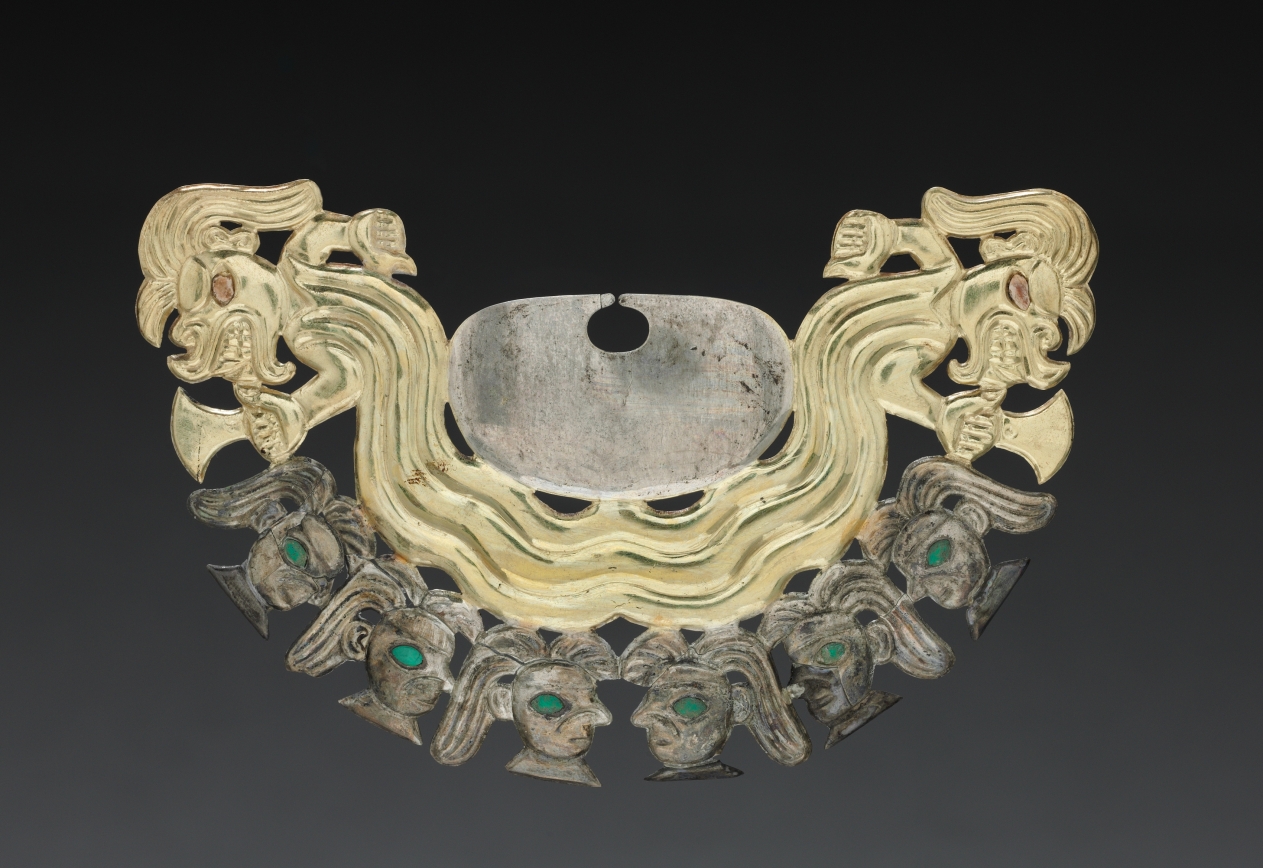
Nose Ornament with Decapitators and Human Heads (c. 100–300 CE) is in the Cleveland Museum of Art collection.
The work and its context
The museum's open-access catalogue describes the work:
A crucial element of Moche royal regalia was the nose ornament, whose imagery varies from benign to predatory. One ornament here depicts a human head, perhaps a ruler’s portrait, flanked by birds that attack human victims. In another, two supernatural decapitators brandish knives over a row of severed human heads. The third is an elegant composition that combines serpents with long-necked water birds. The Moche were among the Andes’ most inventive metalsmiths, and they developed many complex techniques for joining and enriching the surfaces of metals, which they usually worked by hammering rather than casting. The gold-and-silver ornaments were made by first joining gold and silver sheets through heating and hammering. Then came the relief decoration, followed by the selective removal of metal along the joins. Finally, the ornament was trimmed and polished.
Object facts
- Title: Nose Ornament with Decapitators and Human Heads
- Date: c. 100–300 CE
- Culture: Peru, North Coast, Moche culture (50–800 CE), early Intermediate Period
- Type: Metalwork
- Technique: gold alloy and silver
- Dimensions: Overall: 8.8 x 14 cm (3 7/16 x 5 1/2 in.)
- Collection: AA - Andes
- Department: Art of the Americas
- Accession number: 2005.176
Collection credit
Severance and Greta Millikin Purchase Fund
View the collection record
See the museum's photographs and full catalogue entry. Catalogue text is reproduced from the Cleveland Museum of Art's open-access data, with HTML formatting removed. This object and its supplied image are designated CC0.
Sources
More in Lifestyle
Keep reading