Octafoil-shaped Mirror Featuring Ci Fei, the Dragon Slayer (900s–1300s): Art, History and Details
Octafoil-shaped Mirror Featuring Ci Fei, the Dragon Slayer at the Cleveland Museum of Art: 900s–1300s, bronze. Explore the work's context, creator attribution and collection history.
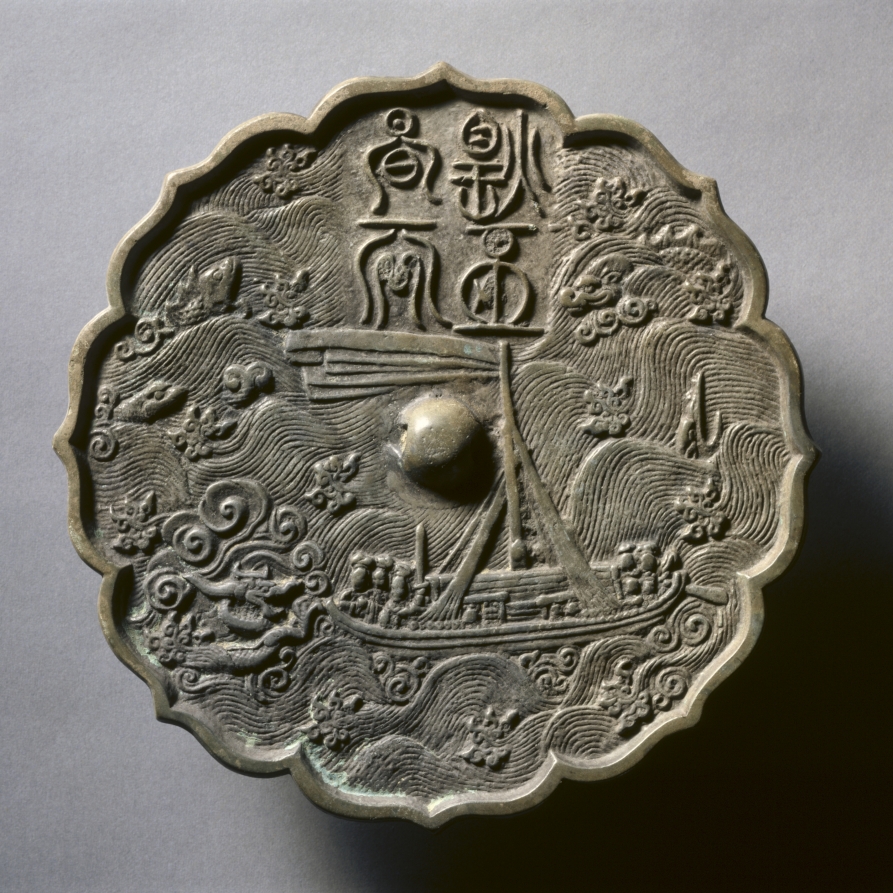
Octafoil-shaped Mirror Featuring Ci Fei, the Dragon Slayer (900s–1300s) is in the Cleveland Museum of Art collection.
The work and its context
The museum's open-access catalogue describes the work:
The mythical hero Ci Fei and his victory during his travel through the Yangzi River is depicted on this eight-lobbed mirror. He raises his sword in order to attack sea monsters. On the top, a large inscription in seal script reads “Great and Resplendent is the Heaven.” The mirror is currently thought to be a Chinese work dating to the Jin Dynasty (1115-1234). Recently published excavation reports, however, reveal that this particular type was exclusively unearthed from Korean tombs of the Goryeo period. Some Korean scholars speculate that this Chinese epic was appropriated to celebrate the Goryeo ruling house’s heroic ancestry and this type of mirror was widely distributed as a token of power among Goryeo elite class members.
Object facts
- Title: Octafoil-shaped Mirror Featuring Ci Fei, the Dragon Slayer
- Date: 900s–1300s
- Culture: China, Jin dynasty (1115-1234) or Korea, Goryeo dynasty (918-1392)
- Type: Metalwork
- Technique: bronze
- Dimensions: Diameter: 17.2 cm (6 3/4 in.); Overall: 1.1 cm (7/16 in.); Rim: 0.5 cm (3/16 in.)
- Collection: China - Song Dynasty
- Department: Chinese Art
- Accession number: 1995.376
Collection credit
Gift of Drs. Thomas and Martha Carter in Honor of Sherman E. Lee
Further reading listed by the museum
- Chou, Ju-hsi. Circles of reflection: the Carter collection of Chinese bronze mirrors. Cleveland, Ohio: Cleveland Museum of Art, 2000.
- Goryeo Dynasty: Korea's Age of Enlightenment, 918-1392. San Francisco: Asian Art Museum, 2003.
- Choi, Eung-chon. “Craftsmen in Metal Arts in the Goryeo Dynasty [고려시대 金屬工藝의 匠人].” Misulsahak yeongu (2004): 171–192.
View the collection record
See the museum's photographs and full catalogue entry. Catalogue text is reproduced from the Cleveland Museum of Art's open-access data, with HTML formatting removed. This object and its supplied image are designated CC0.
Sources
More in Lifestyle
Keep reading