Orestes and Pylades brought to Iphigenia for Sacrifice (1514/1536): Art, History and Details
Orestes and Pylades brought to Iphigenia for Sacrifice at the Cleveland Museum of Art: 1514/1536, engraving. Explore the work's context, creator attribution and collection history.
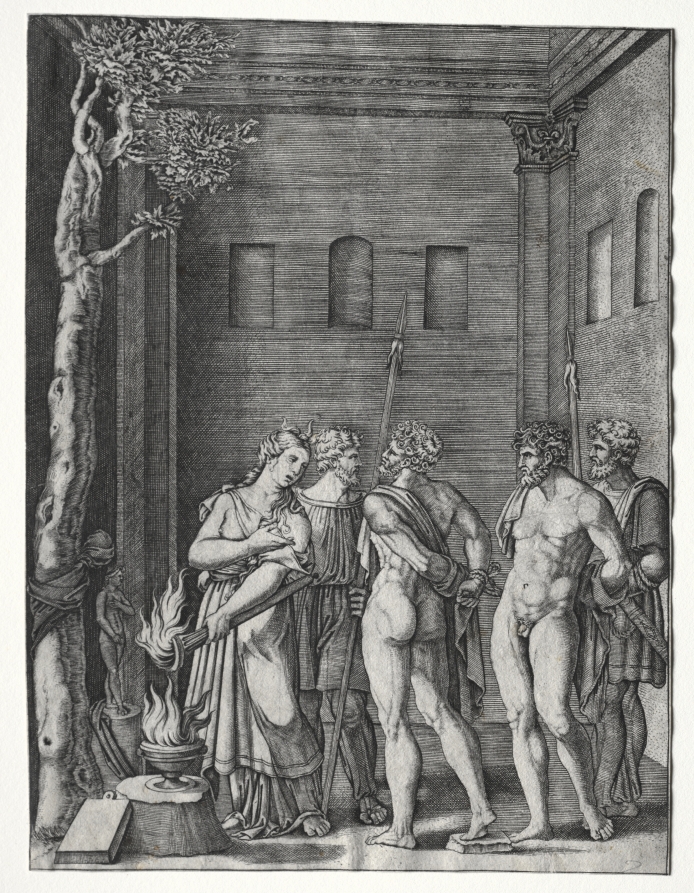
Orestes and Pylades brought to Iphigenia for Sacrifice (1514/1536) is in the Cleveland Museum of Art collection. The museum's creator attribution is Agostino Veneziano (Italian, 1490–1540).
The work and its context
The museum's open-access catalogue describes the work:
This scene comes from Greek mythology. According to one version of the story, Orestes (son of Agamemnon, king of Mycenae) and his companion, Pylades, were sent on a mission to retrieve a sculpture of the goddess Artemis. They were captured, however, and brought to the temple to be sacrificed. Luckily, the temple's high priestess, Iphigenia, turns out to be Orestes's sister, who he believed was sacrificed long before. Overjoyed by their reunion, Iphigenia saves Orestes and Pylades and helps them obtain the statue. Agostino Musi was born in Venice and was a pupil of Giulio Campagnola (about 1482–after 1514) before going to Rome, where he worked under Marcantonio until 1520.
Object facts
- Title: Orestes and Pylades brought to Iphigenia for Sacrifice
- Date: 1514/1536
- Creator attribution: Agostino Veneziano (Italian, 1490–1540)
- Culture: Italy
- Type: Print
- Technique: engraving
- Dimensions: Sheet: 25.9 x 19.4 cm (10 3/16 x 7 5/8 in.)
- Collection: PR - Engraving
- Department: Prints
- Accession number: 1922.464
Collection credit
Gift of Leonard C. Hanna Jr.
View the collection record
See the museum's photographs and full catalogue entry. Catalogue text is reproduced from the Cleveland Museum of Art's open-access data, with HTML formatting removed. This object and its supplied image are designated CC0.
Sources
More in Lifestyle
Keep reading