Ornamental Square from a Tunic (400s): Art, History and Details
Ornamental Square from a Tunic at the Cleveland Museum of Art: 400s, tapestry weave with supplementary weft wrapping; undyed linen and dyed wool. Explore the work's context, creator attribution and collection history.
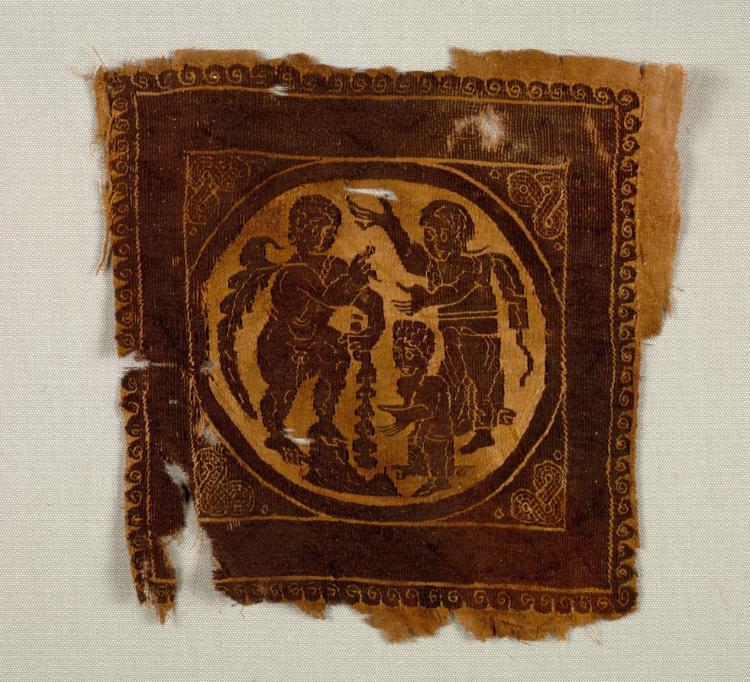
Ornamental Square from a Tunic (400s) is in the Cleveland Museum of Art collection.
The work and its context
The museum's open-access catalogue describes the work:
This mythological scene of the first labor of Hercules––capturing the Nemean lion––originally decorated the front, back, or shoulder of a unisex linen tunic. Hercules was tasked with performing 12 labors as penance for slaying his own wife and children. Here he carries a club with a lion skin slung over his shoulder, serving as impenetrable armor. His companion, Iolaus, carries his bow and quiver on the right. The small figure in the center is unidentified. Knotted ornaments fill the corners, surrounded by a broad purple border edged with a running wave motif.
Object facts
- Title: Ornamental Square from a Tunic
- Date: 400s
- Culture: Egypt, Byzantine period
- Type: Textile
- Technique: tapestry weave with supplementary weft wrapping; undyed linen and dyed wool
- Dimensions: Overall: 16.5 x 16.2 cm (6 1/2 x 6 3/8 in.); Mounted: 24.1 x 23.8 cm (9 1/2 x 9 3/8 in.)
- Collection: T - Coptic
- Department: Textiles
- Accession number: 1982.80
Collection credit
Andrew R. and Martha Holden Jennings Fund
View the collection record
See the museum's photographs and full catalogue entry. Catalogue text is reproduced from the Cleveland Museum of Art's open-access data, with HTML formatting removed. This object and its supplied image are designated CC0.
Sources
More in Lifestyle
Keep reading
Related stories