Orpheus and Cerberus (c. 1765): Art, History and Details
Orpheus and Cerberus at the Cleveland Museum of Art: c. 1765, sandstone. Explore the work's context, creator attribution and collection history.
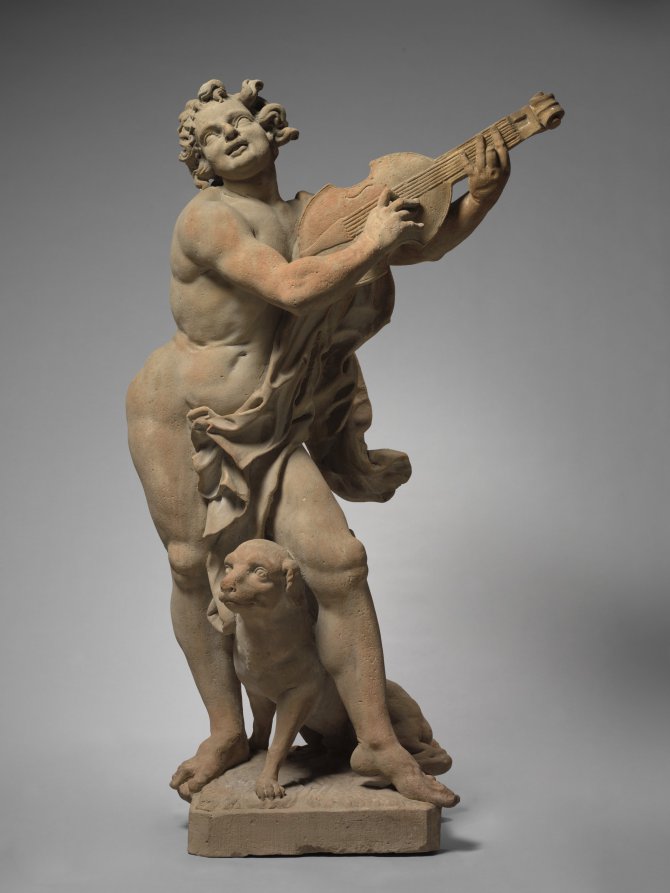
Orpheus and Cerberus (c. 1765) is in the Cleveland Museum of Art collection. The museum's creator attribution is Ferdinand Tietz (Austrian, 1708–1777).
The work and its context
The museum's open-access catalogue describes the work:
This work was one of numerous sculptures Tietz created for the gardens of Schloss Seehof, near Bamberg in Bavaria (Germany), the summer residence of the Prince Bishops of Bamberg. The exaggerated forms of Orpheus's face and musculature caricature the idealized proportions of classical sculpture. A further parody exists with his companion: the usually terrifying hound Cerberus is here nothing more than a docile puppy, sitting calmly at Orpheus's feet. Meant to be viewed outdoors, on a high pedestal and from a distance, this work is less finely detailed than sculptures Tietz made for indoor settings at Seehof.
Object facts
- Title: Orpheus and Cerberus
- Date: c. 1765
- Creator attribution: Ferdinand Tietz (Austrian, 1708–1777)
- Culture: Germany, near Bamberg, 18th century
- Type: Sculpture
- Technique: sandstone
- Dimensions: with base: 304.8 cm (120 in.); Base: 38.1 x 102.9 x 102.9 cm (15 x 40 1/2 x 40 1/2 in.); without base: 182.9 x 106.7 x 61 cm (72 x 42 x 24 in.); Pedestal: 89.5 x 88.9 x 88.9 cm (35 1/4 x 35 x 35 in.)
- Collection: Sculpture
- Department: European Painting and Sculpture
- Accession number: 1971.65
A detail from the museum
Taught to play the lyre by the Greek god Apollo, Orpheus's legendary musical abilities had the power to charm animals.
Collection credit
John L. Severance Fund
Further reading listed by the museum
- Margarete Kämpf, "Das fürstbischöfliche Schloss Seehof bei Bamberg," Bericht des Historischen Vereins Bamberg, nos. 93-94 (1956).
- Erich Herzog, "Verlorene Figuren von Ferdinand Tietz aus dem Park von Schloss Seehof," Mainfränkisches Jahrbuch für Geschichte und Kunst 9 (1959), 234-246
- Klaus Merten, "Schloss und Garten Seehof, Zwischenbilanz einer Liquidation," Maltechnik-Restauro 2 (1972).
View the collection record
See the museum's photographs and full catalogue entry. Catalogue text is reproduced from the Cleveland Museum of Art's open-access data, with HTML formatting removed. This object and its supplied image are designated CC0.
Sources
More in Lifestyle
Keep reading