Outer Staircase of a Gothic Ruin (1830): Art, History and Details
Outer Staircase of a Gothic Ruin at the Cleveland Museum of Art: 1830, gray and brown wash and framing lines in pen and black ink. Explore the work's context, creator attribution and collection history.
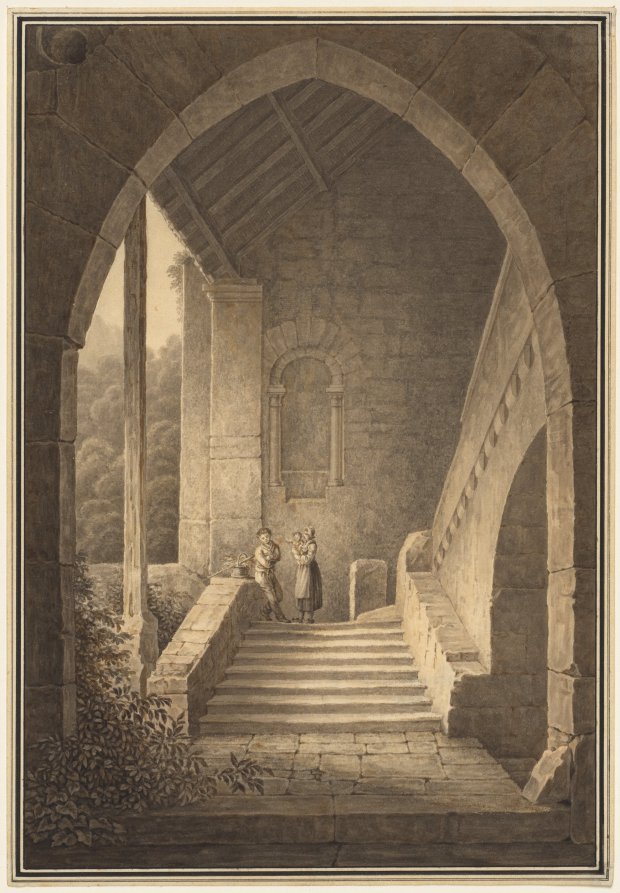
Outer Staircase of a Gothic Ruin (1830) is in the Cleveland Museum of Art collection. The museum's creator attribution is Domenico Quaglio (German, 1787–1837).
The work and its context
The museum's open-access catalogue describes the work:
Rejecting the preference for the landscape and architecture of Italy, as seen in the work of many of his contemporaries, Domenico Quaglio portrayed the buildings of his native Germany. Here, Quaglio depicted a man, woman, and child who are dwarfed by the immense scale of a Gothic cathedral’s ruined arch, within which the figures appear. Overrun by vines and set within a dense forest, the architecture signifies the magnitude of God in the Christian faith and the smallness of mankind.
Object facts
- Title: Outer Staircase of a Gothic Ruin
- Date: 1830
- Creator attribution: Domenico Quaglio (German, 1787–1837)
- Culture: Germany, 19th century
- Type: Drawing
- Technique: gray and brown wash and framing lines in pen and black ink
- Dimensions: Sheet: 24.1 x 16.8 cm (9 1/2 x 6 5/8 in.); Image: 23.2 x 15.2 cm (9 1/8 x 6 in.)
- Collection: DR - German
- Department: Drawings
- Accession number: 1980.218
A detail from the museum
Gothic architecture, the type seen in this drawing, was associated with Germany based on a false assumption that a Germanic tribe, the Goths, had originated the style.
Collection credit
Anonymous gift in honor of Leona E. Prasse
Further reading listed by the museum
- Trost, Brigitte. Domenico Quaglio, 1787-1837: Monographie und Werkverzeichnis. Munich: Prestel, 1973.
- Lee, Sherman E. “The Year in Review for 1980.” The Bulletin of the Cleveland Museum of Art 68, no. 6 (June 1981): 163–219.
View the collection record
See the museum's photographs and full catalogue entry. Catalogue text is reproduced from the Cleveland Museum of Art's open-access data, with HTML formatting removed. This object and its supplied image are designated CC0.
Sources
More in Lifestyle
Keep reading