Owl-shaped Jar (206 BCE–9 CE): Art, History and Details
Owl-shaped Jar at the Cleveland Museum of Art: 206 BCE–9 CE, Amber-brown glazed low-fired pottery. Explore the work's context, creator attribution and collection history.
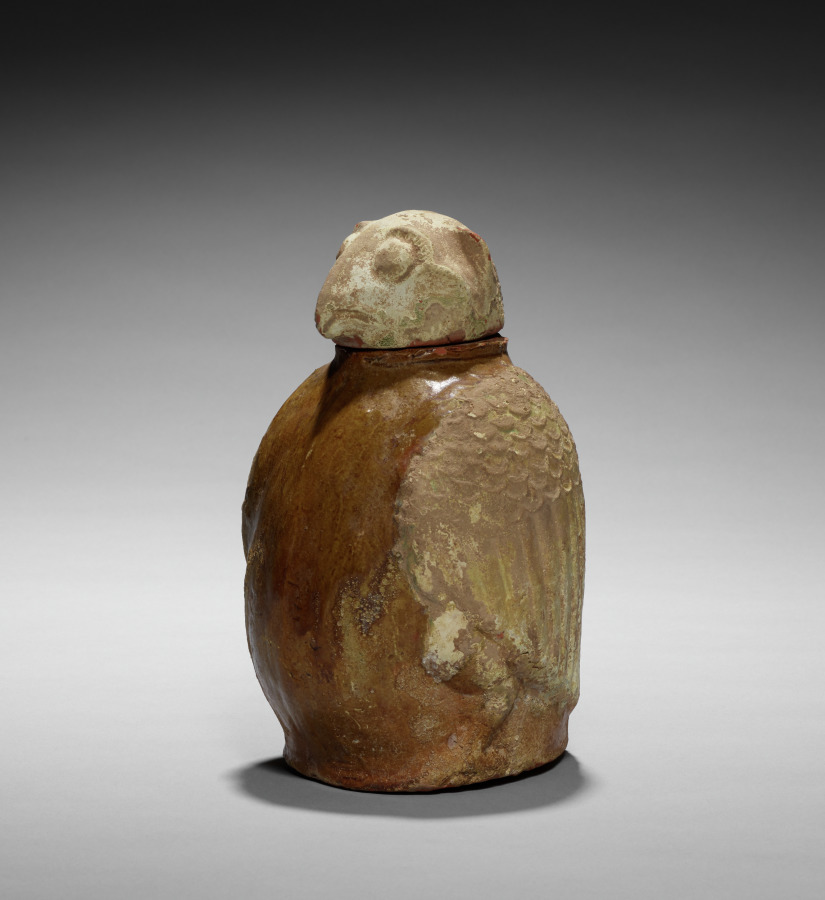
Owl-shaped Jar (206 BCE–9 CE) is in the Cleveland Museum of Art collection.
The work and its context
The museum's open-access catalogue describes the work:
Pottery vessels in the shape of owls were made since Neolithic times and throughout the Bronze age. These jars in the form of vigilant owls may have provided a tomb occupant with grain in the afterlife. However, the meaning of these mysterious birds and the association of the owl motif with burial sites in China is not fully understood.
Object facts
- Title: Owl-shaped Jar
- Date: 206 BCE–9 CE
- Culture: China, Henan province, Western Han dynasty (206 BCE–8 CE)
- Type: Ceramic
- Technique: Amber-brown glazed low-fired pottery
- Dimensions: Overall: 19 x 11.7 x 13.6 cm (7 1/2 x 4 5/8 x 5 3/8 in.)
- Collection: China - Han Dynasty
- Department: Chinese Art
- Accession number: 2020.178.1
A detail from the museum
The jar cover is modeled in the shape of an owl's head.
Collection credit
Nancy F. and Joseph P. Keithley Collection Gift
Further reading listed by the museum
- Von Spee, Clarissa. "Chinese Ceramics and Works on Paper." In The Keithley Collection at the Cleveland Museum of Art, edited by Heather Lemonedes Brown, 194–229. Cleveland, OH: The Cleveland Museum of Art, 2022.
View the collection record
See the museum's photographs and full catalogue entry. Catalogue text is reproduced from the Cleveland Museum of Art's open-access data, with HTML formatting removed. This object and its supplied image are designated CC0.
Sources
More in Lifestyle
Keep reading