Palanquin Ring (1100s–1200s): Art, History and Details
Palanquin Ring at the Cleveland Museum of Art: 1100s–1200s, bronze. Explore the work's context, creator attribution and collection history.
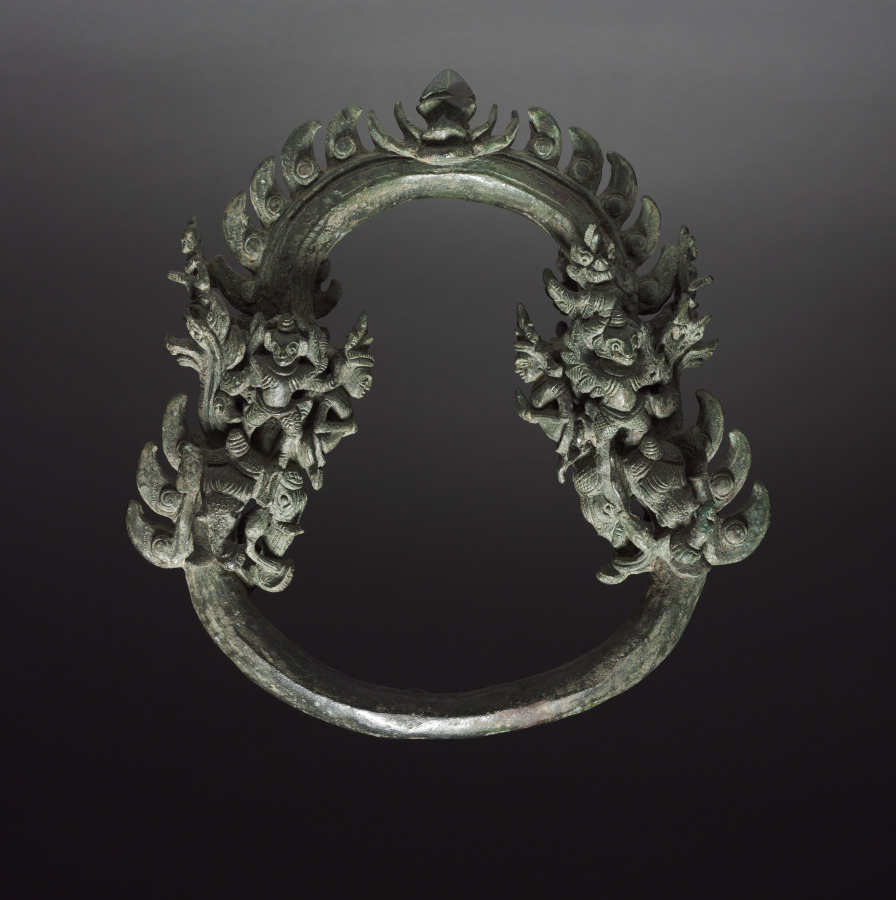
Palanquin Ring (1100s–1200s) is in the Cleveland Museum of Art collection.
The work and its context
The museum's open-access catalogue describes the work:
When members of the royal family or priesthood traveled in a public festival procession to make offerings at a temple or participate in a ceremony, they would be carried in a palanquin, or a covered litter. Portable objects of veneration, such as bronze images or a sacred fire, were also carried on palanquins. The palanquins had wooden poles, hanging seats or raised platforms, and bronze fittings cast in intricate forms and gilt, lending the palanquins a sumptuous quality. This ring, which supported a suspended seat, would have hung on a hook attached to a wooden pole. The body of the ring is shaped in the form of a pair of nagas, or serpents. The flanges, or protrusions, on the top and sides are stylized spines of the serpent’s body, and the heads rear up on either side. In a richly textured cluster of separately cast figures on both sides of the ring are images of composite bird-human, monkey-human, and elephant forms.
Object facts
- Title: Palanquin Ring
- Date: 1100s–1200s
- Culture: Cambodia, probably Angkor
- Type: Sculpture
- Technique: bronze
- Dimensions: Overall: 24.1 x 23 x 6.5 cm (9 1/2 x 9 1/16 x 2 9/16 in.)
- Collection: Cambodian Art
- Department: Indian and Southeast Asian Art
- Accession number: 2011.151
Collection credit
Gift of Dr. Norman Zaworski
View the collection record
See the museum's photographs and full catalogue entry. Catalogue text is reproduced from the Cleveland Museum of Art's open-access data, with HTML formatting removed. This object and its supplied image are designated CC0.
Sources
More in Lifestyle
Keep reading