Panel from a Head Covering (‘Ajar) (probably 1800s or early 1900s): Art, History and Details
Panel from a Head Covering (‘Ajar) at the Cleveland Museum of Art: probably 1800s or early 1900s, Silk, metal, dye. Explore the work's context, creator attribution and collection history.
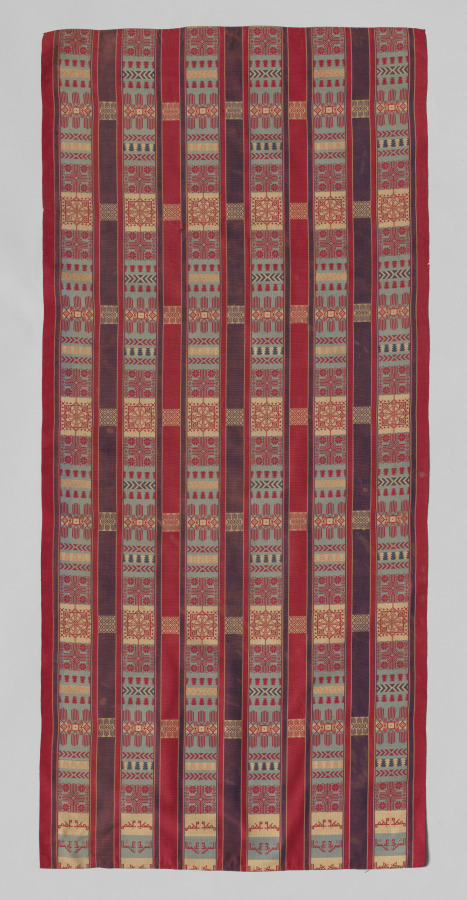
Panel from a Head Covering (‘Ajar) (probably 1800s or early 1900s) is in the Cleveland Museum of Art collection.
The work and its context
The museum's open-access catalogue describes the work:
This panel was part of an urban Tunisian woman’s head-covering (‘ajar). Two such panels flanked a face-obscuring black panel. Such luxurious garments of seclusion were once reserved for elites. The decorative panels draped down when worn, showing off the finely woven motifs and demonstrating the wearer’s family wealth. Arranged in bands, motifs include stylized trees (or protective hands), flowers, eight-pointed stars, and geometric designs. The mirrored Kufic (squared Arabic script) lettering in teal is likely the name of the weaver or panel owner. Weavers with Muslim Andalusian (southern Spanish) heritage originally made these, drawing from Andalusian and Turkish motifs; later, workshops in Tunis produced them.
Object facts
- Title: Panel from a Head Covering (‘Ajar)
- Date: probably 1800s or early 1900s
- Culture: Africa, North Africa, Tunisia, probably Testour or Tunis, Tunisian weaver
- Type: Textile
- Technique: Silk, metal, dye
- Dimensions: Overall: 117.2 x 53.4 cm (46 1/8 x 21 in.)
- Collection: T - Islamic
- Department: Textiles
- Accession number: 1953.320
A detail from the museum
The khamsah (خمسة), an open five-fingered hand, is a protective motif. It is woven in red in multiple ways on this panel.
Collection credit
Purchase from the J. H. Wade Fund
Further reading listed by the museum
- Chakerian, Peter. “'Maghreb' sews artistic traditions of Morocco, Algeria and Tunisia.” The Plain Dealer (Friday, November 1, 2024): D1, D5.
- Gebremedhen, Helina. “Arts of the Maghreb: North African Textiles and Jewelry – Curatorial Reflections.” Journal 18, Issue #19 (Spring 2025).
- Gillow, John. African Textiles: Colour and Creativity Across a Continent. London: Thames & Hudson, 2003.
View the collection record
See the museum's photographs and full catalogue entry. Catalogue text is reproduced from the Cleveland Museum of Art's open-access data, with HTML formatting removed. This object and its supplied image are designated CC0.
Sources
More in Lifestyle
Keep reading