Part of a Skirt (Ghaghara) (early 1800s): Art, History and Details
Part of a Skirt (Ghaghara) at the Cleveland Museum of Art: early 1800s, silk satin embroidered with silk in "ari" chain stitch. Explore the work's context, creator attribution and collection history.
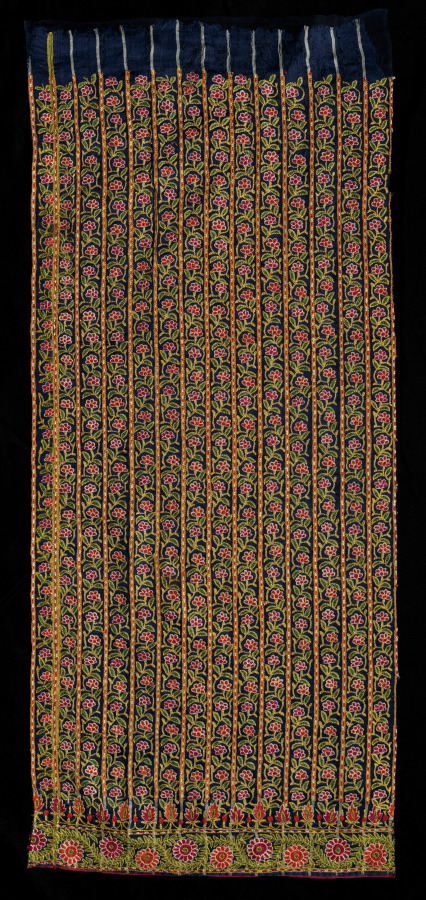
Part of a Skirt (Ghaghara) (early 1800s) is in the Cleveland Museum of Art collection.
The work and its context
The museum's open-access catalogue describes the work:
Brightly colored floral vine patterns were embroidered using fine chain stitches. Since there are continuous, unbroken lines of stitches on the back side of the cloth, they were created using a hooked awl, which is a much faster process than embroidering with a straight needle. This type of embroidery is known as ari work, which flourished in Gujarat during the 19th century.
Object facts
- Title: Part of a Skirt (Ghaghara)
- Date: early 1800s
- Culture: Western India, Gujarat, possibly Kutch
- Type: Embroidery
- Technique: silk satin embroidered with silk in "ari" chain stitch
- Dimensions: Overall: 83.8 x 35.9 cm (33 x 14 1/8 in.)
- Collection: Textiles
- Department: Textiles
- Accession number: 1925.794
A detail from the museum
The renowned art historian A. K. Coomaraswamy (1877–1947) gave another section of this skirt to the Victoria and Albert Museum in London, UK (IM.108-1912).
Collection credit
Purchase from the J. H. Wade Fund
Further reading listed by the museum
- Fotheringham, Avalon. The Indian Textile Sourcebook. 2019.
View the collection record
See the museum's photographs and full catalogue entry. Catalogue text is reproduced from the Cleveland Museum of Art's open-access data, with HTML formatting removed. This object and its supplied image are designated CC0.
Sources
More in Lifestyle
Keep reading