Patera Support: Lasa (300–175 BCE): Art, History and Details
Patera Support: Lasa at the Cleveland Museum of Art: 300–175 BCE, bronze with silver inlays. Explore the work's context, creator attribution and collection history.
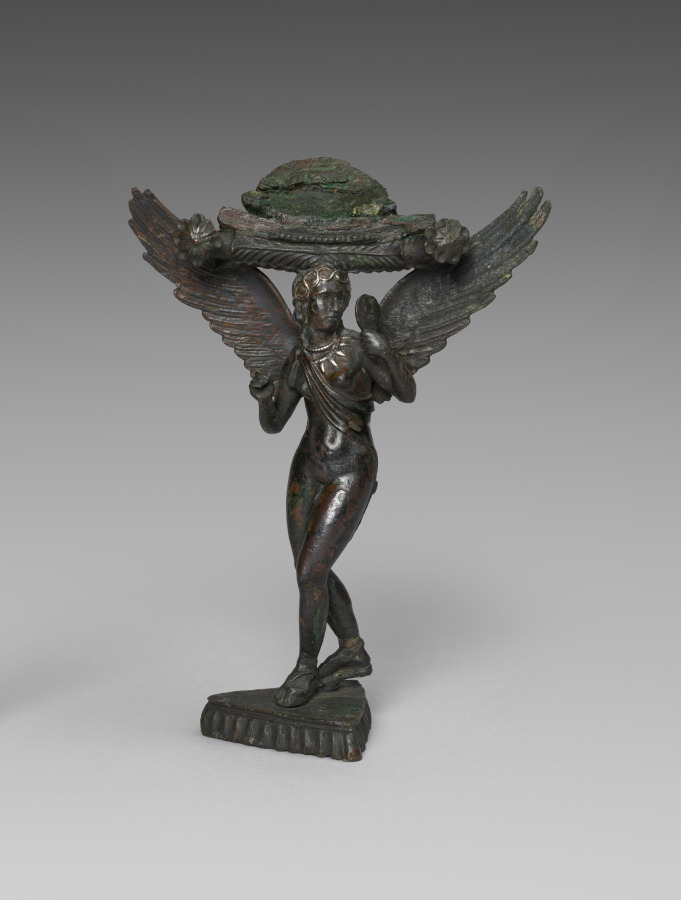
Patera Support: Lasa (300–175 BCE) is in the Cleveland Museum of Art collection.
The work and its context
The museum's open-access catalogue describes the work:
Standing on a triangular base, this winged female figure twists her body while admiring herself in the small mirror held in her left hand. Nearly nude, she wears sandals as well as a leopard or panther skin and jewelry inlaid with silver. Above her head and wings, a small portion of a patera, or shallow offering dish, survives. Inscriptions identify similar winged female figures elsewhere in Etruscan art as Lasas, often together with Turan (an Etruscan goddess analogous to the Greek Aphrodite).
Object facts
- Title: Patera Support: Lasa
- Date: 300–175 BCE
- Culture: Etruscan
- Type: Sculpture
- Technique: bronze with silver inlays
- Dimensions: 18.5 x 9 x 6.2 cm (7 5/16 x 3 9/16 x 2 7/16 in.); Overall: 21.6 x 16.5 x 6.5 cm (8 1/2 x 6 1/2 x 2 9/16 in.)
- Collection: GR - Etruscan
- Department: Greek and Roman Art
- Accession number: 1947.68
A detail from the museum
This elaborate figure served as a handle or support for a patera, a shallow dish.
Collection credit
Purchase from the J. H. Wade Fund
Further reading listed by the museum
- The Brummer Gallery Records. Cloisters (Museum), n.d.
- Wunderlich, Silvia A. "A Bronze Patera Handle." The Bulletin of the Cleveland Museum of Art 34, no. 7 (1947).
- Fasti Archeologici Vol. II (1947).
View the collection record
See the museum's photographs and full catalogue entry. Catalogue text is reproduced from the Cleveland Museum of Art's open-access data, with HTML formatting removed. This object and its supplied image are designated CC0.
Sources
More in Lifestyle
Keep reading