Pawing Bull (500–475 BCE): Art, History and Details
Pawing Bull at the Cleveland Museum of Art: 500–475 BCE, bronze. Explore the work's context, creator attribution and collection history.
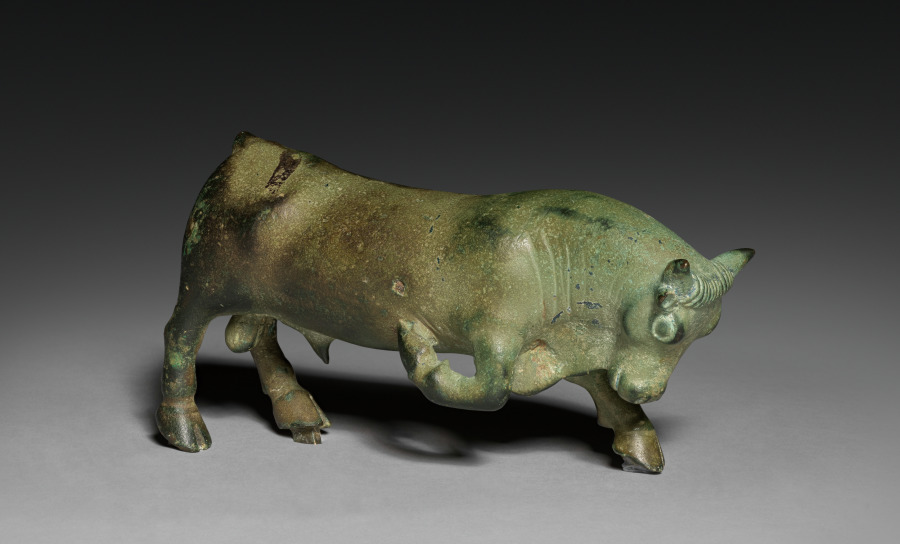
Pawing Bull (500–475 BCE) is in the Cleveland Museum of Art collection.
The work and its context
The museum's open-access catalogue describes the work:
With its head slightly lowered and right foreleg raised in a pawing motion, this robust bull seems poised for action. The pose closely resembles that of bulls on coins minted at Thurii, a Greek colony in South Italy, but the statuette seems earlier in date and could have other associations. Perhaps the bull once carried the princess Europa, for example, or battled a lion or a hero. Alternatively, it may have stood alone as a small-scale offering, representing the actual bulls sometimes sacrificed to deities.
Object facts
- Title: Pawing Bull
- Date: 500–475 BCE
- Culture: South Italy, Lucania, Greek
- Type: Sculpture
- Technique: bronze
- Dimensions: Overall: 10.6 x 5 cm (4 3/16 x 1 15/16 in.)
- Collection: GR - Greek
- Department: Greek and Roman Art
- Accession number: 1930.336
A detail from the museum
This solid-cast bronze bull is nearly intact, missing only its tail.
Collection credit
Purchase from the J. H. Wade Fund
Further reading listed by the museum
- S. Wunderlich. "A Statuette of a Bull." The Bulletin of the Cleveland Museum of Art 18, no. 3 (1931): 52-54.
- Jantzen, Ulf. Bronzewerkstätten in Grossgriechenland und Sizilien. Berlin: W. de Gruyter, 1937.
- Fraser, A.D. "The Bronze Bull in Cleveland," Humanistic Studies in Honor of John Calvin Metcalf, University of Virginia Studies, vol. 1 (Charlottesville, VA, 1941): 1-11.
View the collection record
See the museum's photographs and full catalogue entry. Catalogue text is reproduced from the Cleveland Museum of Art's open-access data, with HTML formatting removed. This object and its supplied image are designated CC0.
Sources
More in Lifestyle
Keep reading