Pedestal Bowl (c. 900–1519): Art, History and Details
Pedestal Bowl at the Cleveland Museum of Art: c. 900–1519, earthenware with colored slips. Explore the work's context, creator attribution and collection history.
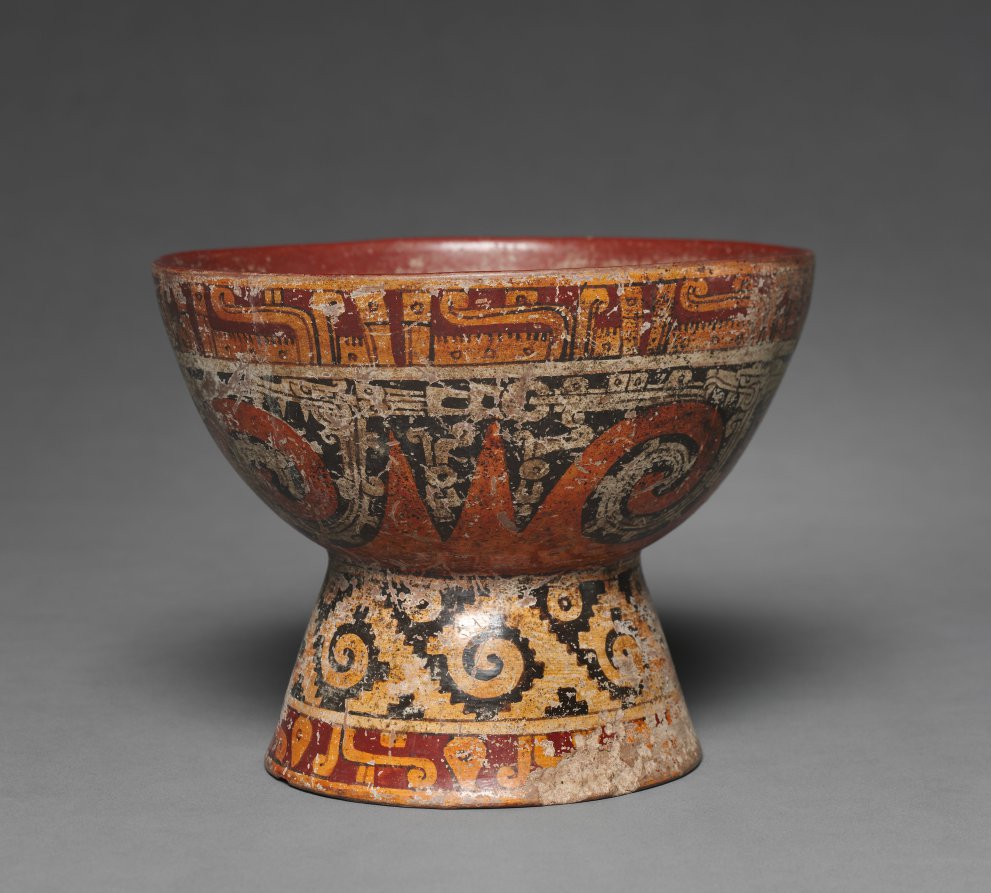
Pedestal Bowl (c. 900–1519) is in the Cleveland Museum of Art collection.
The work and its context
The museum's open-access catalogue describes the work:
The nobility may have used these goblets for a chocolate beverage or for pulque, made from the fermented sap of the maguey cactus. Both are painted with the precision and brilliant colors for which the Mixteca-Puebla style is renowned, and they carry some of the same motifs, such as the band of stylized animal heads at the top. The smaller bowl has a rattle base.
Object facts
- Title: Pedestal Bowl
- Date: c. 900–1519
- Culture: Mexico, Cholula?, Mixteca-Puebla Style, 10th-16th century
- Type: Ceramic
- Technique: earthenware with colored slips
- Dimensions: Diameter: 14.4 x 18.6 cm (5 11/16 x 7 5/16 in.); Overall: 14.6 cm (5 3/4 in.)
- Collection: AA - Mesoamerica
- Department: Art of the Americas
- Accession number: 1951.317
Collection credit
John L. Severance Fund
Further reading listed by the museum
- "Illustrations." Liturgical Arts 23, no. 3 (May 1955): 101-120.
- Cleveland Museum of Art, and Jenifer Neils. The World of Ceramics: Masterpieces from the Cleveland Museum of Art. Cleveland: Museum in cooperation with Indiana University Press, 1982.
- Kubler, George. The Art and Architecture of Ancient America: The Mexican, Maya, and Andean Peoples. Harmondsworth, Middlesex: Penguin Books, 1984.
View the collection record
See the museum's photographs and full catalogue entry. Catalogue text is reproduced from the Cleveland Museum of Art's open-access data, with HTML formatting removed. This object and its supplied image are designated CC0.
Sources
More in Lifestyle
Keep reading