Pedestal (mid-700s): Art, History and Details
Pedestal at the Cleveland Museum of Art: mid-700s, ivory. Explore the work's context, creator attribution and collection history.
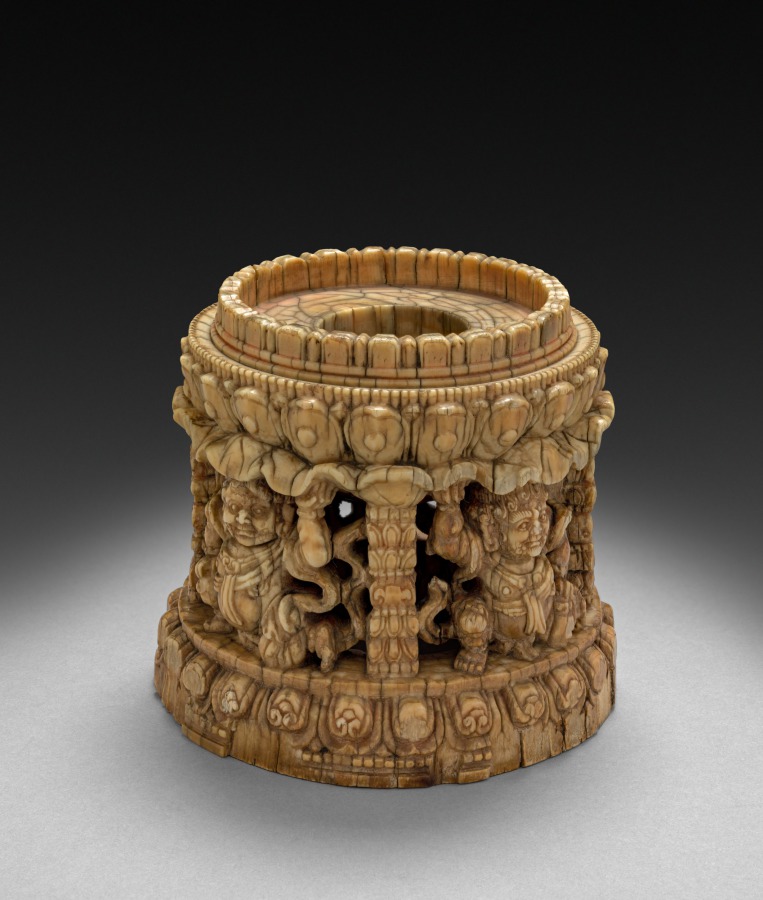
Pedestal (mid-700s) is in the Cleveland Museum of Art collection.
The work and its context
The museum's open-access catalogue describes the work:
Small circular pedestal or stand for an icon or figure, most probably a Buddha. Starting from the base of the pedestal, there is a band of pearling or beading, a row of everted lotus petals, four dwarf-like creatures alternating with four square columns, a lotus leaf, another row of lotus petals, their stamens and anthers, and finally a row of alternating large and small elements retaining traces of a red stain and probably representing stylized lotus petals. The pedestal is in the form of a well-known type, the double lotus pedestal (visvapadma), which was particularly popular in the second half of the sixth century, being found in most of the Chinese cave sites of that period. This pedestal however, represents a later continuation of the type.
Object facts
- Title: Pedestal
- Date: mid-700s
- Culture: China, Tang dynasty (618-907)
- Type: Sculpture
- Technique: ivory
- Dimensions: Overall: 7.8 cm (3 1/16 in.); Diameter of base: 9 cm (3 9/16 in.)
- Collection: China - Tang Dynasty
- Department: Chinese Art
- Accession number: 1968.70
Collection credit
Gift of Mr. and Mrs. Frederick M. Mayer
Further reading listed by the museum
- Lerner, Martin. “A Seventh-Century Chinese Buddhist Ivory.” The Bulletin of the Cleveland Museum of Art 55, no. 9 (November 1968): 294–303.
- Oriental Ceramic Society, and British Museum. Chinese Ivories: From the Shang to the Qing: an Exhibition. [London]: The Society, 1984.
View the collection record
See the museum's photographs and full catalogue entry. Catalogue text is reproduced from the Cleveland Museum of Art's open-access data, with HTML formatting removed. This object and its supplied image are designated CC0.
Sources
More in Lifestyle
Keep reading