Pendant (1300s): Art, History and Details
Pendant at the Cleveland Museum of Art: 1300s, silk, silvered paper, gilded paper, and gold thread; needleloop embroidery and knotting. Explore the work's context, creator attribution and collection history.
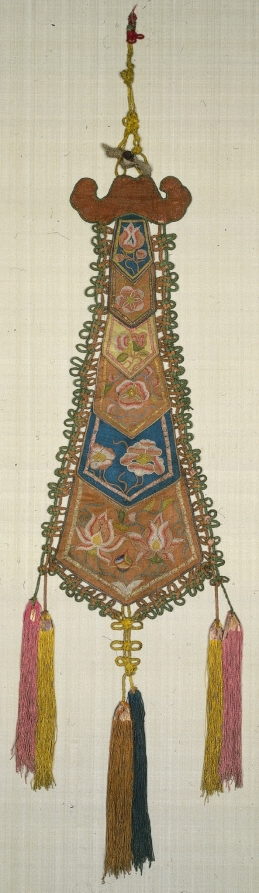
Pendant (1300s) is in the Cleveland Museum of Art collection.
The work and its context
The museum's open-access catalogue describes the work:
Pendants were used extensively in Buddhist settings where they were attached to almost anything needing decoration: ritual objects, canopies, valances, pillars, and other architectural components. They could be made in a variety of ways. This example consists of a heading and six tiers, each embroidered separately and then attached, one to the next. The earliest known pendant of this type was found in Central Asia and dates from the Tang dynasty (618–907). The 14th-century date of this pendant is indicated by the style of the flowers.
Object facts
- Title: Pendant
- Date: 1300s
- Culture: China
- Type: Embroidery
- Technique: silk, silvered paper, gilded paper, and gold thread; needleloop embroidery and knotting
- Dimensions: Overall: 84.5 x 21.7 cm (33 1/4 x 8 9/16 in.)
- Collection: Textiles
- Department: Textiles
- Accession number: 1994.20
Collection credit
Edward L. Whittemore Fund
Further reading listed by the museum
- Cleveland Museum of Art, “Recent Acquisitions to the Cleveland Museum of Art Collection,” August 26, 1994, Cleveland Museum of Art Archives.
- Watt, James C. Y., Anne E. Wardwell, and Morris Rossabi. When silk was gold: Central Asian and Chinese textiles. New York: Metropolitan Museum of Art in cooperation with the Cleveland Museum of Art: Distributed by H.N. Abrams, 1997.
View the collection record
See the museum's photographs and full catalogue entry. Catalogue text is reproduced from the Cleveland Museum of Art's open-access data, with HTML formatting removed. This object and its supplied image are designated CC0.
Sources
More in Lifestyle
Keep reading