Pendant (1700s): Art, History and Details
Pendant at the Cleveland Museum of Art: 1700s, Gold, emerald, diamonds, enamel, and pearl. Explore the work's context, creator attribution and collection history.
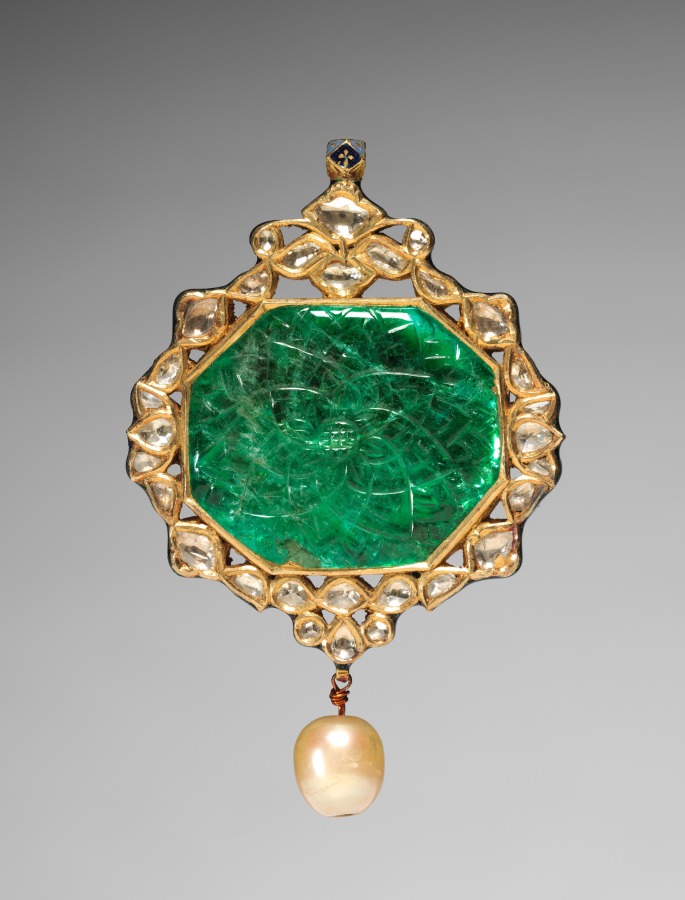
Pendant (1700s) is in the Cleveland Museum of Art collection.
The work and its context
The museum's open-access catalogue describes the work:
The large green emerald on one side of this pendant was probably imported to India from Columbia. Delicately incised with a lotus blossom, a symbol of the sun, it is surrounded by inset diamonds in organic, petal-like shapes. Emeralds, especially prized for their green color, were associated with the planet Mercury in Hindu astrology and with the power to ward off evil in Islam. On the reverse, a peacock and two peahens surrounded by flowers are rendered using blue, green, and red glass.
Object facts
- Title: Pendant
- Date: 1700s
- Culture: Northwestern India, Rajasthan, Rajput Kingdom of Jaipur
- Type: Jewelry
- Technique: Gold, emerald, diamonds, enamel, and pearl
- Dimensions: Overall: 7.4 x 4.8 cm (2 15/16 x 1 7/8 in.)
- Collection: Indian Art
- Department: Indian and Southeast Asian Art
- Accession number: 1966.515.a
A detail from the museum
The bright color of the emerald indicates it was sourced in South America.
Collection credit
Bequest of Anne Jessop Smith
View the collection record
See the museum's photographs and full catalogue entry. Catalogue text is reproduced from the Cleveland Museum of Art's open-access data, with HTML formatting removed. This object and its supplied image are designated CC0.
Sources
More in Lifestyle
Keep reading