Pendant with Four-armed Green Vishnu on a lotus with Nagas (1600s or 1700s): Art, History and Details
Pendant with Four-armed Green Vishnu on a lotus with Nagas at the Cleveland Museum of Art: 1600s or 1700s, Gold set with precious and semiprecious stones. Explore the work's context, creator attribution and collection history.
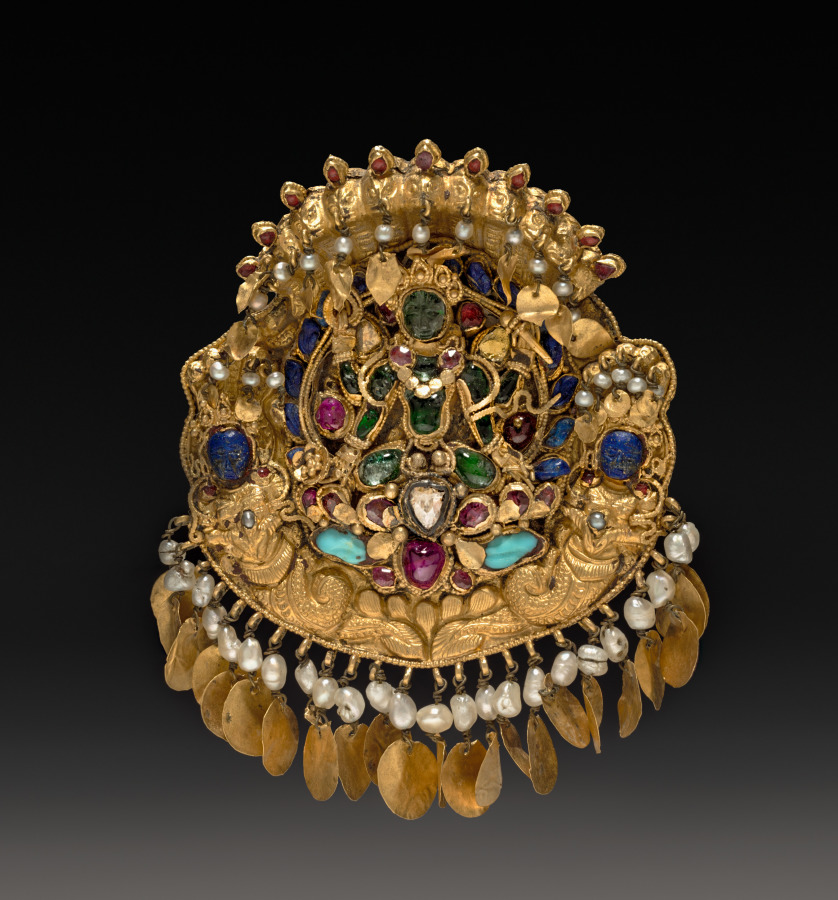
Pendant with Four-armed Green Vishnu on a lotus with Nagas (1600s or 1700s) is in the Cleveland Museum of Art collection.
The work and its context
The museum's open-access catalogue describes the work:
Vishnu, made of emeralds, holds his typical emblems, each made of gold: a discus in his upper right hand, the club in his upper left, and a lotus in his lower right hand. He sits cross-legged on a lotus pedestal made of spinels, nestled on the back of his mount, Garuda, shown with a crystal face, spinel torso, and turquoise wings. The intertwined bodies of nagas (serpent deities) form the bottom of this pendant; each naga holds a pearl in offering; their faces are carved from lapis lazuli. An eleven-headed serpent hood rears over the entire ensemble.
Object facts
- Title: Pendant with Four-armed Green Vishnu on a lotus with Nagas
- Date: 1600s or 1700s
- Culture: Nepal, Kathmandu Valley
- Type: Jewelry
- Technique: Gold set with precious and semiprecious stones
- Dimensions: Overall: 7.2 x 5.8 cm (2 13/16 x 2 5/16 in.)
- Collection: Nepalese Art
- Department: Indian and Southeast Asian Art
- Accession number: 1915.340
A detail from the museum
In Nepal and South India, the Hindu god Vishnu can be shown as either blue or green.
Collection credit
Gift of Mr. and Mrs. J. H. Wade
View the collection record
See the museum's photographs and full catalogue entry. Catalogue text is reproduced from the Cleveland Museum of Art's open-access data, with HTML formatting removed. This object and its supplied image are designated CC0.
Sources
More in Lifestyle
Keep reading
Related stories


