Peonies (mid 1700s): Art, History and Details
Peonies at the Cleveland Museum of Art: mid 1700s, hanging scroll; ink and color on paper. Explore the work's context, creator attribution and collection history.
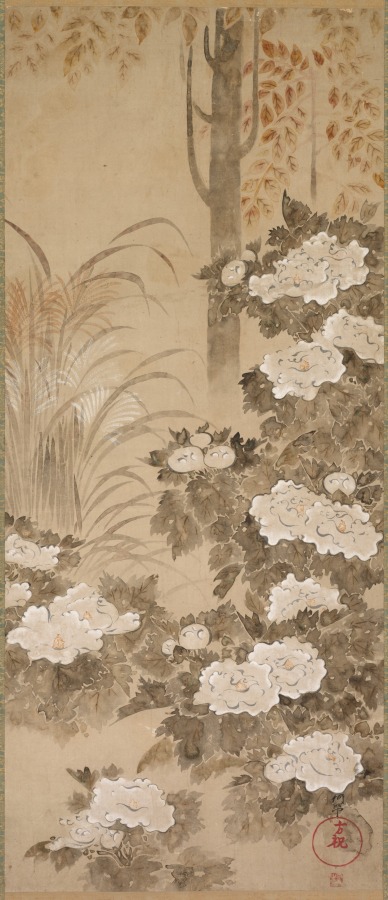
Peonies (mid 1700s) is in the Cleveland Museum of Art collection. The museum's creator attribution is Tatebayashi Kagei (Japanese, active mid-1700s).
The work and its context
The museum's open-access catalogue describes the work:
A proliferation of white tree peonies dominates this composition. Behind them are tall, feathery-topped susuki grasses and leafy deciduous trees. Tatebayashi Kagei restricted his palette to ink with red and white color, along with sparing use of green in the peony leaves and the blades of grass. He made generous use of the “dripping-in” (tarashikomi) technique, layering pooled ink and color, in the peony leaves. The areas left in reserve create the impression of insect-eaten or late season foliage.
Object facts
- Title: Peonies
- Date: mid 1700s
- Creator attribution: Tatebayashi Kagei (Japanese, active mid-1700s)
- Culture: Japan, Edo period (1615–1868)
- Type: Painting
- Technique: hanging scroll; ink and color on paper
- Dimensions: Painting only: 90.9 x 36.2 cm (35 13/16 x 14 1/4 in.)
- Collection: ASIAN - Hanging scroll
- Department: Japanese Art
- Accession number: 1964.105
A detail from the museum
In 1738, Kagei received a copy made by Ogata Kōrin of a fan painting by Tawaraya Sōtatsu from Kōrin's brother Ogata Kenzan, so some think he trained with Kenzan in Edo (present-day Tokyo).
Collection credit
Worcester R. Warner Collection
Further reading listed by the museum
- Lee, Sherman E. "Sōsetsu and Flowers." The Bulletin of the Cleveland Museum of Art 57, no. 8 (1970): 263-71.
View the collection record
See the museum's photographs and full catalogue entry. Catalogue text is reproduced from the Cleveland Museum of Art's open-access data, with HTML formatting removed. This object and its supplied image are designated CC0.
Sources
More in Lifestyle
Keep reading