Perfume Bottle (Alabastron) (c. 325–275 BCE): Art, History and Details
Perfume Bottle (Alabastron) at the Cleveland Museum of Art: c. 325–275 BCE, glass. Explore the work's context, creator attribution and collection history.
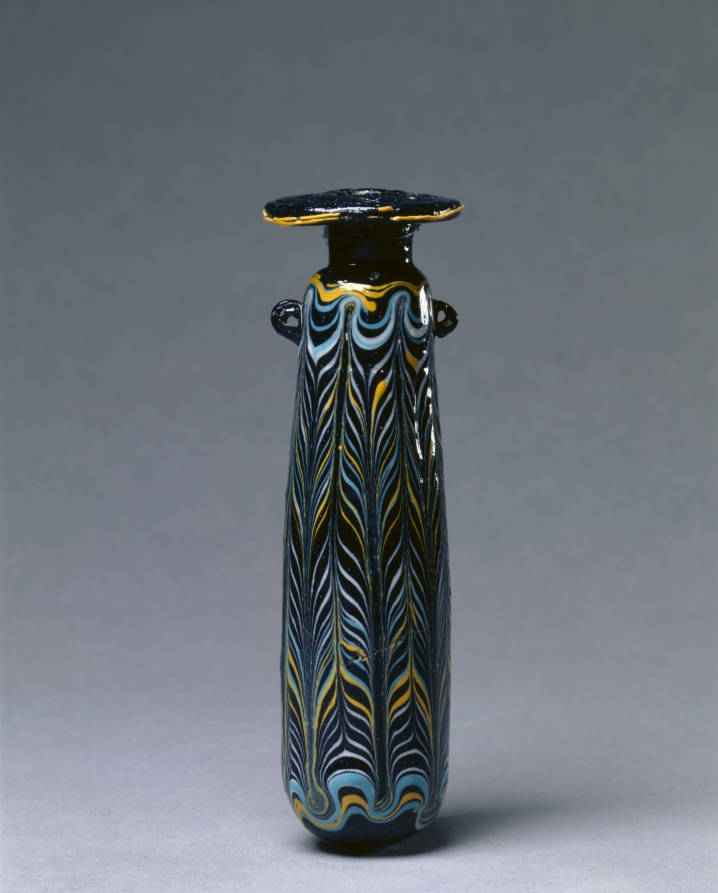
Perfume Bottle (Alabastron) (c. 325–275 BCE) is in the Cleveland Museum of Art collection.
The work and its context
The museum's open-access catalogue describes the work:
Before glassblowing was invented in about 50 BC, glass bottles were formed by winding molten glass around a mud or dung core much the way cotton candy is wrapped around a paper cone. Later, the core was scraped out leaving a hollow bottle to be filled with expensive perfumes or scented oils.
Object facts
- Title: Perfume Bottle (Alabastron)
- Date: c. 325–275 BCE
- Culture: Italy or Eastern Mediterranean, Etruscan
- Type: Glass
- Technique: glass
- Dimensions: Diameter: 5.1 cm (2 in.); Overall: 16.5 cm (6 1/2 in.)
- Collection: GR - Etruscan
- Department: Greek and Roman Art
- Accession number: 1994.9
Collection credit
Purchase from the J. H. Wade Fund
Further reading listed by the museum
- Cleveland Museum of Art, “Recent Acquisitions to the Cleveland Museum of Art Collection,” August 26, 1994, Cleveland Museum of Art Archives.
- Kozloff, Arielle. 1996. "Is There an Alexandrian Style--What Is Egyptian about It?" in Alexandria and Alexandrianism: Papers Delivered at a Symposium Organized by The J. Paul Getty Museum, and J. Paul Getty Center for the History of Art and the Humanities. Malibu, Calif.: J. Paul Getty Museum, 1996, pp. 247-260.
View the collection record
See the museum's photographs and full catalogue entry. Catalogue text is reproduced from the Cleveland Museum of Art's open-access data, with HTML formatting removed. This object and its supplied image are designated CC0.
Sources
More in Lifestyle
Keep reading