Pharmacy Jar (Albarello) (c. 1475–80): Art, History and Details
Pharmacy Jar (Albarello) at the Cleveland Museum of Art: c. 1475–80, tin-glazed earthenware (maiolica). Explore the work's context, creator attribution and collection history.
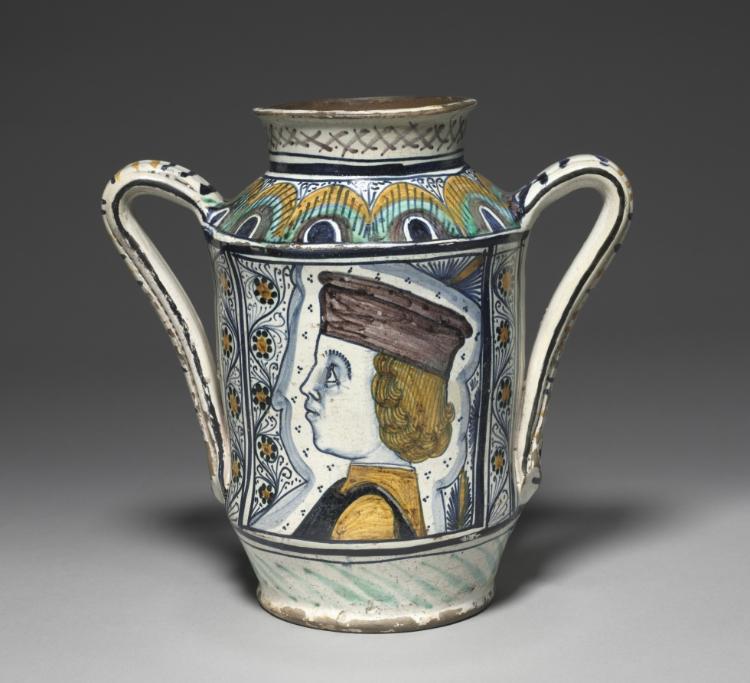
Pharmacy Jar (Albarello) (c. 1475–80) is in the Cleveland Museum of Art collection.
The work and its context
The museum's open-access catalogue describes the work:
Storage jars that lined the shelves of Renaissance pharmacies often held medicinal herbs, spices, and ointments. Their shape made them easy to grasp while the flared lip allowed apothecaries to seal off the contents with parchment or cloth secured by a string. A scroll on the back of this vessel indicates that it may have once held a peony compound.
Object facts
- Title: Pharmacy Jar (Albarello)
- Date: c. 1475–80
- Culture: Italy, Florentine region, Cafaggiolo
- Type: Ceramic
- Technique: tin-glazed earthenware (maiolica)
- Dimensions: Overall: 30.5 cm (12 in.)
- Collection: Decorative Arts
- Department: Decorative Art and Design
- Accession number: 1941.550
A detail from the museum
At various points in history, medicinal peony compounds have been prescribed for dizziness, weakness, hysteria, jaundice, and kidney stones.
Collection credit
Purchase from the J. H. Wade Fund
Further reading listed by the museum
- Sotheby's. Catalogue of the Very Choice Collection of Old Italian Majolica and Hispoano-Moresque Ware. June 16, 1938.Sotheby's: London, 1938. Lot 68.
- The Cleveland Museum of Art. The Cleveland Museum of Art Handbook. Cleveland, OH: The Cleveland Museum of Art, 1958.
- The Cleveland Museum of Art. Handbook of the Cleveland Museum of Art/1966. Cleveland, OH: The Cleveland Museum of Art, 1966.
View the collection record
See the museum's photographs and full catalogue entry. Catalogue text is reproduced from the Cleveland Museum of Art's open-access data, with HTML formatting removed. This object and its supplied image are designated CC0.
Sources
More in Lifestyle
Keep reading