Piping and Dancing Satyr (300–100 BCE): Art, History and Details
Piping and Dancing Satyr at the Cleveland Museum of Art: 300–100 BCE, bronze. Explore the work's context, creator attribution and collection history.
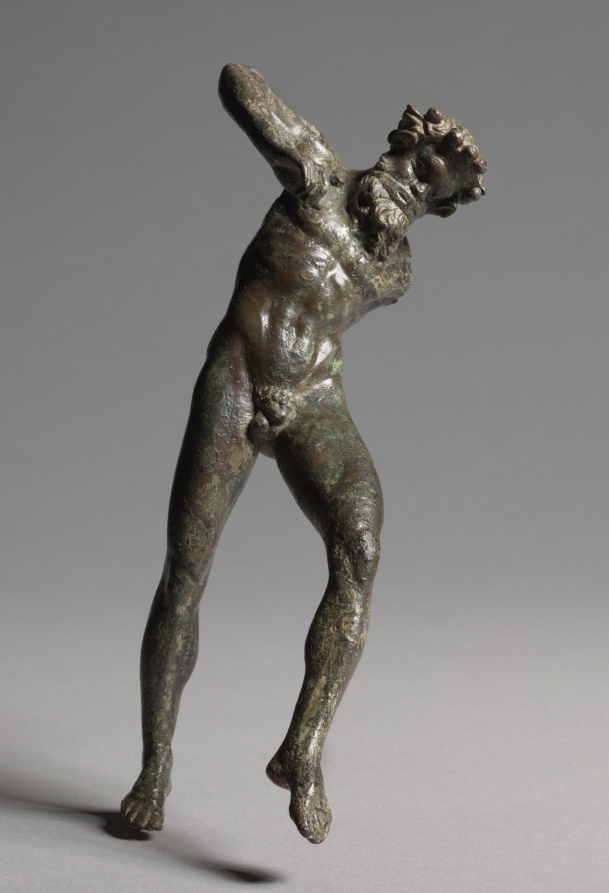
Piping and Dancing Satyr (300–100 BCE) is in the Cleveland Museum of Art collection.
The work and its context
The museum's open-access catalogue describes the work:
With its long limbs and unbalanced pose, this bronze statuette captures a male figure in the middle of a dance. His pointed ears, snub nose, and berry crown mark him as a satyr, a part-man, part-horse follower of Dionysos, the Greek god of wine and revelry. He probably once held auloi (musical pipes), to judge from the placement and shape of his right hand, plus the strap around his mouth; his left arm is now missing. Composed of multiple cast pieces joined together, the dynamic pose of this statuette shows the Hellenistic interest in movement and the body.
Object facts
- Title: Piping and Dancing Satyr
- Date: 300–100 BCE
- Culture: Greece, Alexandria(?)
- Type: Sculpture
- Technique: bronze
- Dimensions: Overall: 21 cm (8 1/4 in.)
- Collection: GR - Greek
- Department: Greek and Roman Art
- Accession number: 1945.366
A detail from the museum
The special strap around the satyr’s mouth to help him play the pipes is called a phorbeia.
Collection credit
Purchase from the J. H. Wade Fund
Further reading listed by the museum
- Comstock, Helen. "A Group of Greek Bronze Statuettes." The International Studio LXXXIV. New York. 1926.
- Wunderlich, Silvia A. “A Bronze Satyr.” The Bulletin of the Cleveland Museum of Art 33, no. 4 (1946): 35–36.
- The Cleveland Museum of Art. The Cleveland Museum of Art Handbook. Cleveland, OH: The Cleveland Museum of Art, 1958.
View the collection record
See the museum's photographs and full catalogue entry. Catalogue text is reproduced from the Cleveland Museum of Art's open-access data, with HTML formatting removed. This object and its supplied image are designated CC0.
Sources
More in Lifestyle
Keep reading