Plaque with Inlaid Peony and Chrysanthemum Design (1200s): Art, History and Details
Plaque with Inlaid Peony and Chrysanthemum Design at the Cleveland Museum of Art: 1200s, celadon with inlaid decoration. Explore the work's context, creator attribution and collection history.
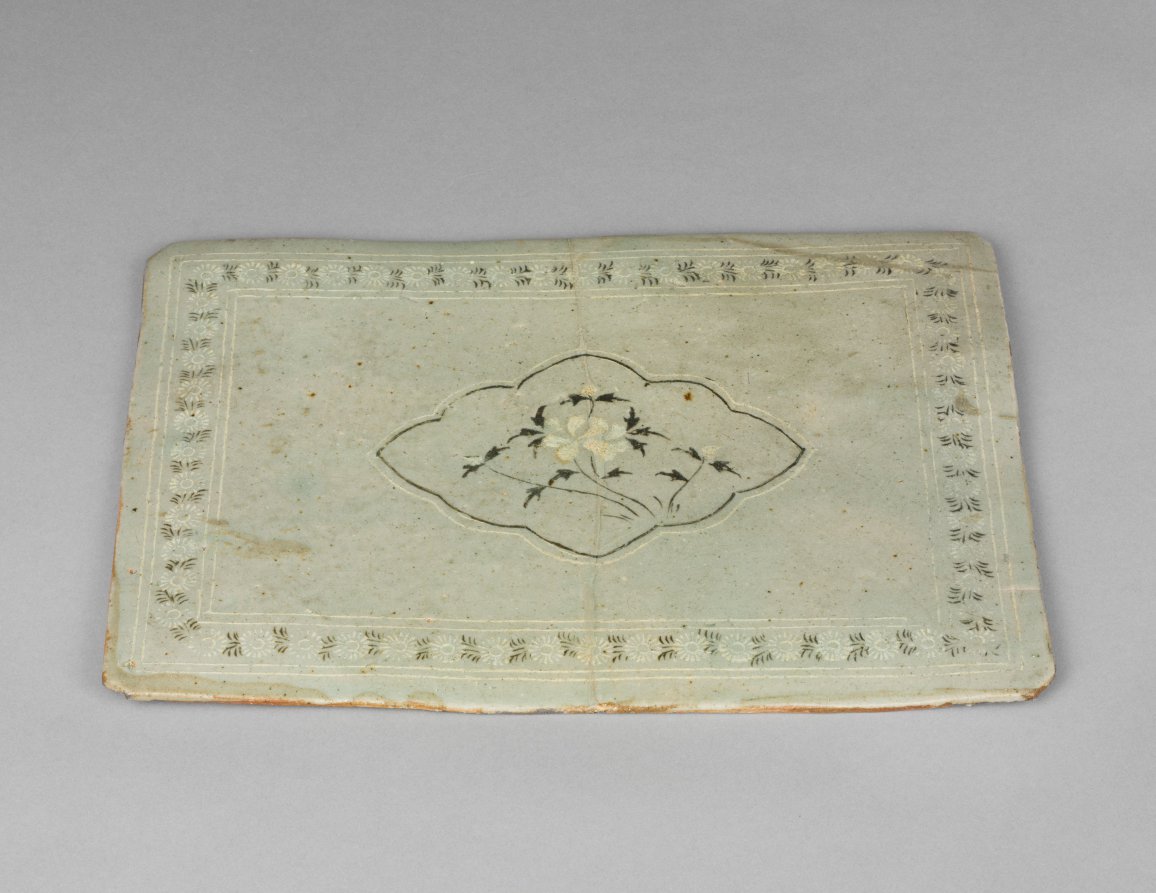
Plaque with Inlaid Peony and Chrysanthemum Design (1200s) is in the Cleveland Museum of Art collection.
The work and its context
The museum's open-access catalogue describes the work:
Celadons, spoons, seals, and bronze mirrors were the most common burial objects in tombs during the Goryeo period (918-1392). Furnishing tombs with an elaborate assemblage of objects was believed to honor and comfort the newly dead. This type of celadon tile, elegantly adorned with the image of flowers such as bloomed peonies and chrysanthemums, was used to embellish the interior of buildings.
Object facts
- Title: Plaque with Inlaid Peony and Chrysanthemum Design
- Date: 1200s
- Culture: Korea, Goryeo dynasty (918–1392)
- Type: Ceramic
- Technique: celadon with inlaid decoration
- Dimensions: Overall: 19.1 x 25.4 x 0.3 cm (7 1/2 x 10 x 1/8 in.)
- Collection: Korean Art
- Department: Korean Art
- Accession number: 1918.490
A detail from the museum
Celadon tiles such as this one were mainly produced in state kilns located in Kangjin and Buan, Jeolla province.
Collection credit
Gift of John L. Severance
Further reading listed by the museum
- Lee, Young-hee. "The Study on the Craft technique of Koryo Dynasty-Centering on Interrelation [고려시대 공예기법 연구 상호관련성을 중심으로]." Misulsa hakbo (2004): 133-170.
- Goryeo Dynasty: Korea's Age of Enlightenment, 918-1392. San Francisco: Asian Art Museum, 2003.
- Goryeo: The Glory of Korea [대고려, 그 찬란한 도전]. Seoul: National Museum of Korea, 2018.
View the collection record
See the museum's photographs and full catalogue entry. Catalogue text is reproduced from the Cleveland Museum of Art's open-access data, with HTML formatting removed. This object and its supplied image are designated CC0.
Sources
More in Lifestyle
Keep reading