Plate with Arms of the Vitelleschi Family (1527): Art, History and Details
Plate with Arms of the Vitelleschi Family at the Cleveland Museum of Art: 1527, tin-glazed earthenware with gold luster (maiolica). Explore the work's context, creator attribution and collection history.
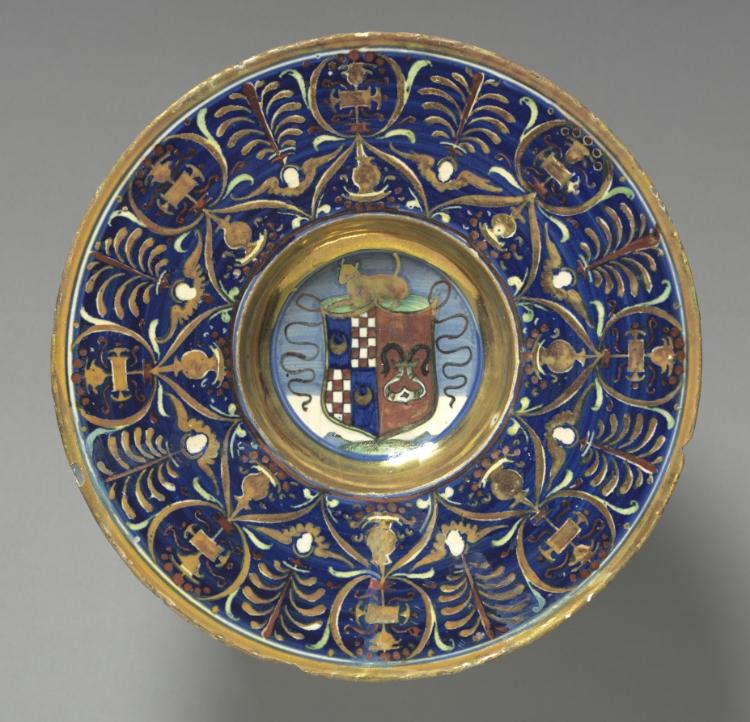
Plate with Arms of the Vitelleschi Family (1527) is in the Cleveland Museum of Art collection. The museum's creator attribution is Maestro Giorgio Andreoli (Italian, 1465?–1553).
The work and its context
The museum's open-access catalogue describes the work:
Italian nobles of the 1500s often expressed their wealth, social status, and sophistication by ordering large sets of maiolica that sometimes carried their coats of arms or even likenesses, usually in profile as in portraits of the period. Reserved for use at festival events such as a wedding or commissioned to mark a special occasion or an important visit, elaborately decorated utilitarian vessels in maiolica were prized as works of art by their owners and displayed as such in their residences.
Object facts
- Title: Plate with Arms of the Vitelleschi Family
- Date: 1527
- Creator attribution: Maestro Giorgio Andreoli (Italian, 1465?–1553)
- Culture: Italy, Urbino region, Gubbio
- Type: Ceramic
- Technique: tin-glazed earthenware with gold luster (maiolica)
- Dimensions: Diameter: 26.3 cm (10 3/8 in.)
- Collection: Decorative Arts
- Department: Decorative Art and Design
- Accession number: 1950.155
A detail from the museum
Today, the Palazzo Vitelleschi, home of the Vitelleschi family in Tarquinia, a coastal town north of Rome, is an archaeological museum.
Collection credit
Purchase from the J. H. Wade Fund
Further reading listed by the museum
- Milliken, William M. “Three Majolica Plates by Maestro Giorgio.” The Bulletin of the Cleveland Museum of Art 37, no. 10 (December 1950): 211–13.
View the collection record
See the museum's photographs and full catalogue entry. Catalogue text is reproduced from the Cleveland Museum of Art's open-access data, with HTML formatting removed. This object and its supplied image are designated CC0.
Sources
More in Lifestyle
Keep reading