Plate with Bird and Flower (early 1900s): Art, History and Details
Plate with Bird and Flower at the Cleveland Museum of Art: early 1900s, Porcelain with overglaze enamel (Ko-Kutani revival style). Explore the work's context, creator attribution and collection history.
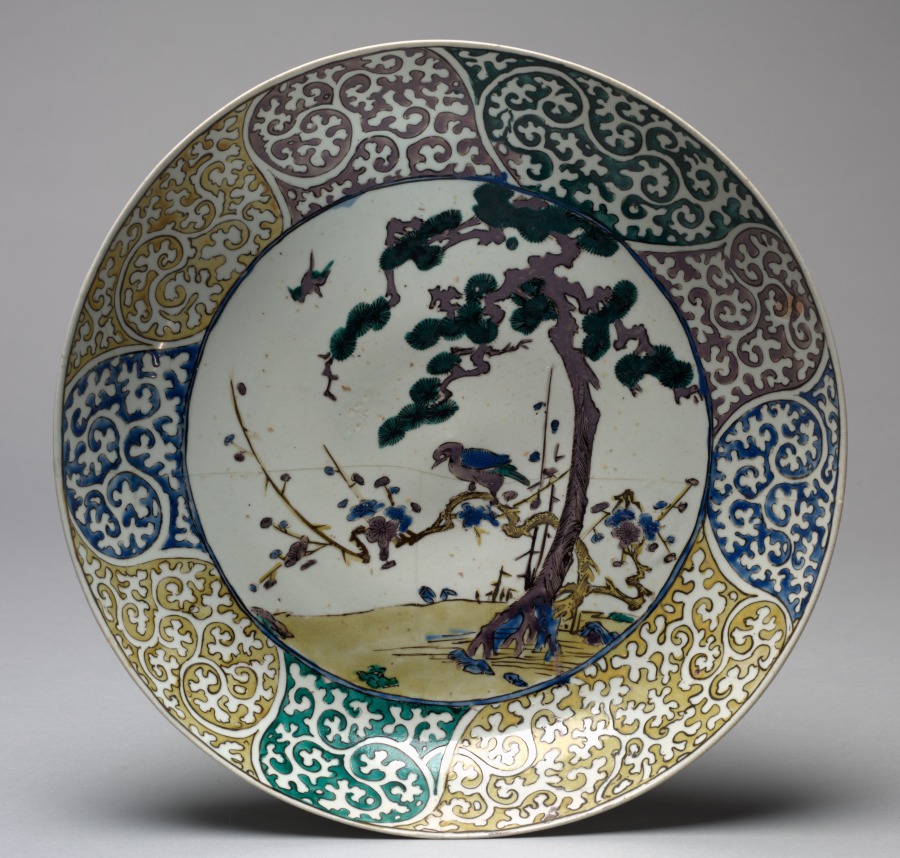
Plate with Bird and Flower (early 1900s) is in the Cleveland Museum of Art collection.
The work and its context
The museum's open-access catalogue describes the work:
This dish is a sophisticated example of later ceramists reinterpreting earlier styles of Japanese porcelain. The colors and patterns used look similar to some works produced on the island of Kyushu in the1600s and 1700s. However, the idea to combine alternating blocks of yellow, green, purple, and blue with a "Chinese grasses" (karakusa) pattern around the rim of the dish is one hit upon in the early 1900s by an artist familiar with the colors and patterns of earlier works.
Object facts
- Title: Plate with Bird and Flower
- Date: early 1900s
- Culture: Japan, Meiji period (1868–1912) or Taishō period (1912–26)
- Type: Ceramic
- Technique: Porcelain with overglaze enamel (Ko-Kutani revival style)
- Dimensions: Diameter: 37.5 cm (14 3/4 in.)
- Collection: Japanese Art
- Department: Japanese Art
- Accession number: 1969.253
A detail from the museum
Porcelain must be fired at a high temperature to achieve its strength and semitranslucent surface.
Collection credit
Gift of Mrs. Terrence O. Kennedy in memory of her husband, Terrence O. Kennedy
Further reading listed by the museum
- Cleveland Museum of Art, and Jenifer Neils. The World of Ceramics: Masterpieces from the Cleveland Museum of Art. Cleveland: Museum in cooperation with Indiana University Press, 1982.
View the collection record
See the museum's photographs and full catalogue entry. Catalogue text is reproduced from the Cleveland Museum of Art's open-access data, with HTML formatting removed. This object and its supplied image are designated CC0.
Sources
More in Lifestyle
Keep reading