Poros Assailed by the Macedonian Army (recto); Sketches of Animals (verso) (c. 1545/47): Art, History and Details
Poros Assailed by the Macedonian Army (recto); Sketches of Animals (verso) at the Cleveland Museum of Art: c. 1545/47, pen and brown ink (iron gall) and brush and brown wash; framing lines in gold paint. Explore the work's context, creator
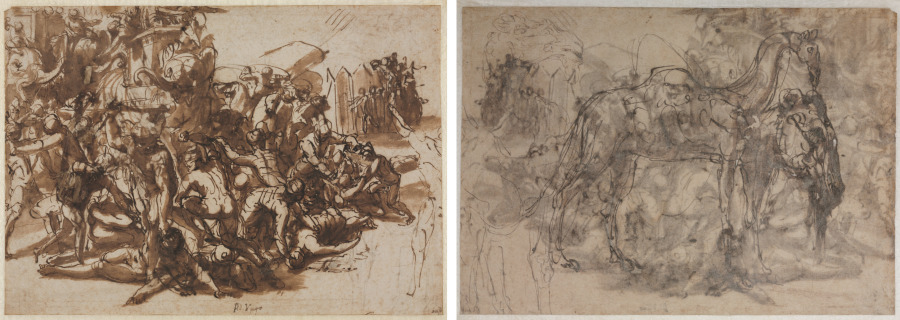
Poros Assailed by the Macedonian Army (recto); Sketches of Animals (verso) (c. 1545/47) is in the Cleveland Museum of Art collection. The museum's creator attribution is Perino del Vaga (Italian, 1501–1547).
The work and its context
The museum's open-access catalogue describes the work:
Perino del Vaga made this spirited pen and ink and wash drawing as a preliminary sketch for a fresco cycle depicting the military campaigns of Alexander the Great, intended for the apartments of Pope Paul III in the Castel Sant’Angelo in Rome. At the time, he was also working on commissions at the Vatican Palace where he studied and drew from the frescoes of Michelangelo in the Sistine Chapel. One pose in the drawing, that of the man in front who, sword poised over his head, prepares to strike a man below, was probably inspired by Michelangelo’s rendering of David and Goliath on the ceiling. Perino adapted the violent pose for a military rather than biblical subject, filling out the scene with trumpeting elephants and a pile of soldiers in combat. On the verso of the sheet, Perino drew a quick sketch of a standing camel and another, closer view of the animal's head and legs.
Object facts
- Title: Poros Assailed by the Macedonian Army (recto); Sketches of Animals (verso)
- Date: c. 1545/47
- Creator attribution: Perino del Vaga (Italian, 1501–1547)
- Culture: Italy
- Type: Drawing
- Technique: pen and brown ink (iron gall) and brush and brown wash; framing lines in gold paint
- Dimensions: Sheet: 19.3 x 27.4 cm (7 5/8 x 10 13/16 in.); Secondary Support: 22.5 x 30.5 cm (8 7/8 x 12 in.)
- Collection: DR - Italian
- Department: Drawings
- Accession number: 1992.3
A detail from the museum
This artist was in Rome in 1527 when the troops of Charles V sacked the city, and was imprisoned and forced to pay a heavy ransom for his, his wife's, and his daughter's safe release.
Collection credit
Delia E. Holden and L. E. Holden Funds
Further reading listed by the museum
- Turner, Evan H. "The Year in Review for 1992." The Bulletin of the Cleveland Museum of Art 80, no. 2 (February 1993): 38-79.
- Kliemann, Julian. "Rom, Engelsburg, Sala Paolina." In Wandmalerei in Italien: Die Ziet der Hochrenaissance und des Manierismus 1510-1600, edited by Julian Kliemann and Michael Rohlmann, 352-369. Munich: Hirmer Verlag, 2004.
- Kliemann, Julian. "Rome, Castel Sant'Angelo, Sala Paolina." In Italian Frescoes, High Renaissance and Mannerism, 1510-1600, edited by Julian Kliemann and Michael Rohlmann and translated by Steven Lindberg, 352-369. New York: Abbeville Press, 2004.
View the collection record
See the museum's photographs and full catalogue entry. Catalogue text is reproduced from the Cleveland Museum of Art's open-access data, with HTML formatting removed. This object and its supplied image are designated CC0.
Sources
More in Lifestyle
Keep reading