Portable Buddhist Temple (900s): Art, History and Details
Portable Buddhist Temple at the Cleveland Museum of Art: 900s, Kaolin with traces of pigment. Explore the work's context, creator attribution and collection history.
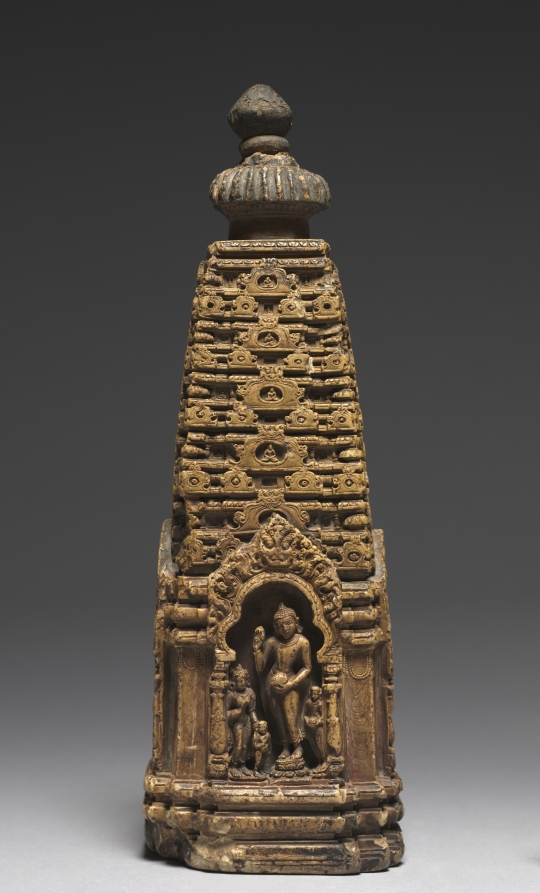
Portable Buddhist Temple (900s) is in the Cleveland Museum of Art collection.
The work and its context
The museum's open-access catalogue describes the work:
The large niches on each side contain scenes from the life of the Buddha. The first features his mother Maya after his miraculous birth. The second and fourth depict his triumph over the forces of evil that attempted to frighten and seduce him away from the path to enlightenment. The third scene takes place after he has established a monastic following and depicts his wife bringing their son to meet him. Kaolinite is a compacted mineral that approximates ivory in its ability to be carved with fine details. Visitors to sacred Buddhist sites would commission portable sculptures such as this to commemorate their pious pilgrimage.
Object facts
- Title: Portable Buddhist Temple
- Date: 900s
- Culture: Eastern India, Bihar
- Type: Sculpture
- Technique: Kaolin with traces of pigment
- Dimensions: Overall: 28 x 9 x 9 cm (11 x 3 9/16 x 3 9/16 in.)
- Collection: Indian Art
- Department: Indian and Southeast Asian Art
- Accession number: 1971.167
Collection credit
John L. Severance Fund
Further reading listed by the museum
- Lee, Sherman E. “The Year in Review for 1971.” The Bulletin of the Cleveland Museum of Art, vol. 59, no. 1, 1972, pp. 3–46.
- Huntington, Susan L., and John C. Huntington. Leaves from the Bodhi Tree: The Art of Pāla India (8th-12th Centuries) and Its International Legacy. Dayton, OH: Dayton Art Institute in association with the University of Washington Press, 1990.
- Banerji, Naseem A. "The mihrabs in the Adina Mosque: evidence of the reuse of late Pala-Sena remains." Marg 50, Issue 3 (March 1999), pp. 82–93.
View the collection record
See the museum's photographs and full catalogue entry. Catalogue text is reproduced from the Cleveland Museum of Art's open-access data, with HTML formatting removed. This object and its supplied image are designated CC0.
Sources
More in Lifestyle
Keep reading