Portable Triptych Icon (1600s): Art, History and Details
Portable Triptych Icon at the Cleveland Museum of Art: 1600s, painted wood panel within enameled brass frame. Explore the work's context, creator attribution and collection history.
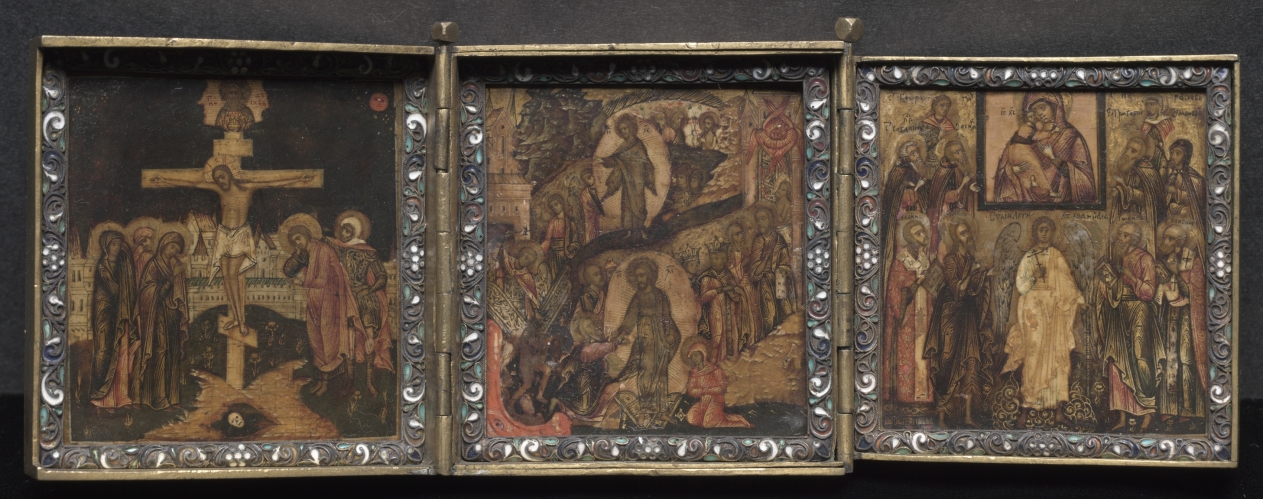
Portable Triptych Icon (1600s) is in the Cleveland Museum of Art collection.
The work and its context
The museum's open-access catalogue describes the work:
This triptych icon was probably commissioned by a lay person for private prayer and meditation. It could be folded and shut when not in use. The scenes represented from left to right are: The Crucifixion (left); The Resurrection and Anastasis (center); and Adoration of the Miracle-Working Icon of the Vladimir Mother of God (right). Small portable icons such as this were common to later Russian religious practice.
Object facts
- Title: Portable Triptych Icon
- Date: 1600s
- Culture: Byzantium, Russia, Moscow?, Byzantine period, 17th century
- Type: Painting
- Technique: painted wood panel within enameled brass frame
- Dimensions: Unframed: 6.5 x 6 x 0.2 cm (2 9/16 x 2 3/8 x 1/16 in.); Closed: 7.3 x 6.9 x 3.4 cm (2 7/8 x 2 11/16 x 1 5/16 in.); Open and extended: 7 x 19.1 cm (2 3/4 x 7 1/2 in.)
- Collection: MED - Byzantine
- Department: Medieval Art
- Accession number: 1961.35
Collection credit
Gift of Mrs. Harry F. Stratton
Further reading listed by the museum
- The Cleveland Museum of Art. The Cleveland Museum of Art Catalogue of Paintings, Part 3: European Paintings of the 16th, 17th, and 18th Centuries. Cleveland, OH: The Cleveland Museum of Art, 1982.
View the collection record
See the museum's photographs and full catalogue entry. Catalogue text is reproduced from the Cleveland Museum of Art's open-access data, with HTML formatting removed. This object and its supplied image are designated CC0.
Sources
More in Lifestyle
Keep reading