Portrait of a Man and Portrait of a Woman (pair) (c. 1795): Art, History and Details
Portrait of a Man and Portrait of a Woman (pair) at the Cleveland Museum of Art: c. 1795, watercolor on ivory in a period gold and hair frame. Explore the work's context, creator attribution and collection history.
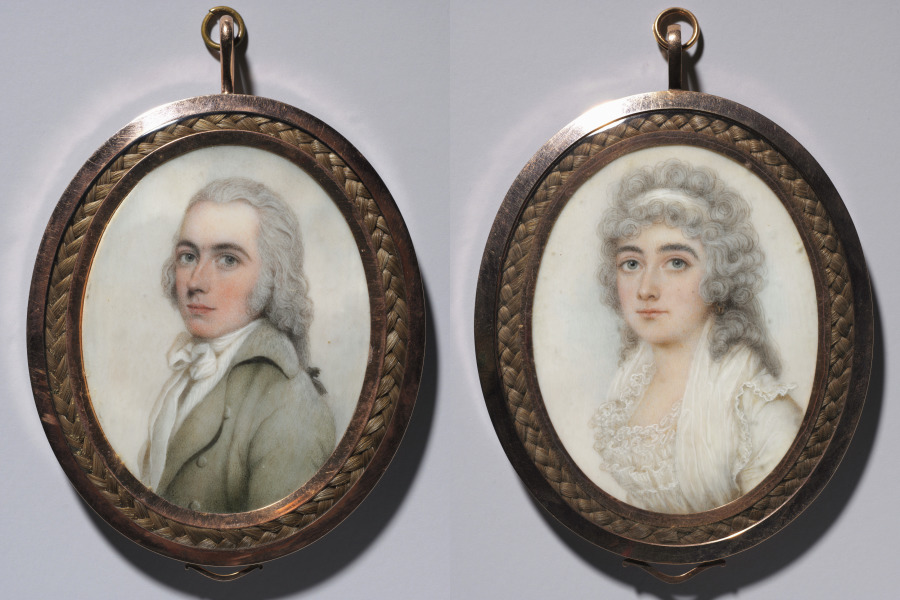
Portrait of a Man and Portrait of a Woman (pair) (c. 1795) is in the Cleveland Museum of Art collection. The museum's creator attribution is Nathaniel Plimer (British, 1757–1822).
The work and its context
The museum's open-access catalogue describes the work:
The man's powdered hair is tied with a dark bow below the shoulders. He has gray eyes and wears a greenish-gray coat, white shirt, and cravat tied in a bow under his chin. The background is very pale, with ivory ground visible, but faintly light blue close to the head. Among the hallmarks of Nathaniel Plimer’s technique was the use of delicate stippling for the shadows of the face and the application of individual dots of paint to create the lower lid eyelashes. The woman wears a wide, white ribbon bandeau in her powdered, curly hair, which falls to her shoulders. She has blue eyes and dark brows; a gold earring is visible in her left ear. The bust line of her white cotton gown is trimmed with many layers of ruffles, and she wears a fi chu around her neck and shoulders. The background is very pale, with ivory ground visible, but faintly light blue close to the head. The female portrait is slightly larger than the male, and both date from c. 1795, the date at which a British man would have worn his hair powdered and his cravat tied in a bow and a British woman would have been wearing this type of ruffled muslin gown and a bandeau in her long hair. It is impossible to know for certain if these unidentified sitters were married, but the fact that they are housed in identical frames, which date from the same period as the paintings, suggests that they are a pair. Although husbands and wives often commissioned portraits in miniature simultaneously, the pairs were frequently divided over time through inheritance, loss, breakage, or independent sale. Both miniatures are housed in identical, wonderfully elaborate period gold frames with braided hairwork. The blue glass back of each has a plait of brown hair in its center. The hair incorporated into the framing of each miniature is approximately the same color, suggesting either that the couple had the same color hair or that the same hair was used in each frame. Traditionally, it was the hair of the sitter that was mounted with his or her miniature portrait.
Object facts
- Title: Portrait of a Man and Portrait of a Woman (pair)
- Date: c. 1795
- Creator attribution: Nathaniel Plimer (British, 1757–1822)
- Culture: England, 18th century
- Type: Portrait Miniature
- Technique: watercolor on ivory in a period gold and hair frame
- Dimensions: Framed: 9.2 x 7.7 cm (3 5/8 x 3 1/16 in.); Sight: 6.7 x 5.3 cm (2 5/8 x 2 1/16 in.)
- Collection: P - British before 1800
- Department: European Painting and Sculpture
- Accession number: 1941.562
A detail from the museum
They are both unsigned, as was typical for Plimer’s works during this period.
Collection credit
The Edward B. Greene Collection
Further reading listed by the museum
- Cleveland Museum of Art. Portrait Miniatures ; The Edward B. Greene Collection. Cleveland, OH: The Cleveland Museum of Art, 1951.
- Foskett, Daphne. A Dictionary of British Miniature Painters. London: Faber and Faber, 1972.
- Cleveland Museum of Art, and Alan Chong. European & American Painting in the Cleveland Museum of Art: A Summary Catalogue. Cleveland, Ohio: Cleveland Museum of Art, 1993.
View the collection record
See the museum's photographs and full catalogue entry. Catalogue text is reproduced from the Cleveland Museum of Art's open-access data, with HTML formatting removed. This object and its supplied image are designated CC0.
Sources
More in Lifestyle
Keep reading