Portrait of a Man, Possibly Sir Soulden Lawrence (1770): Art, History and Details
Portrait of a Man, Possibly Sir Soulden Lawrence at the Cleveland Museum of Art: 1770, watercolor on ivory in an amalgam frame. Explore the work's context, creator attribution and collection history.
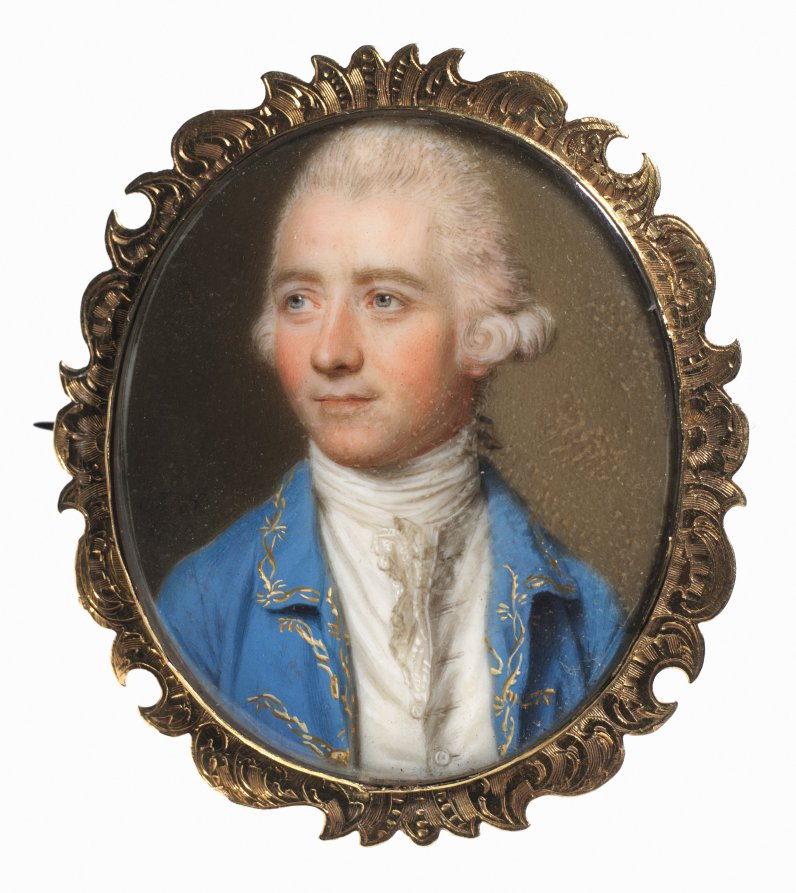
Portrait of a Man, Possibly Sir Soulden Lawrence (1770) is in the Cleveland Museum of Art collection. The museum's creator attribution is John I Smart (British, 1741–1811).
The work and its context
The museum's open-access catalogue describes the work:
This portrait is an excellent example of John Smart’s early work. The unknown sitter has blue eyes and wears a light blue coat embroidered in gold, a white waistcoat, and a high white collar with a lace frill down the front. He also dons a powdered wig—still fashionable in 1770. While the sitter’s cheeks are flushed with a delicate pink, his complexion does not have the ruddy quality so often seen in Smart’s later work. The intricate gold embroidery on the sitter’s jacket exemplifies the ornamentation lavished upon menswear during the early and mid-eighteenth century—a male fashion trend replaced two decades later by one that stressed greater sobriety. The date on the miniature is difficult to decipher but probably reads 1770. Not only is the date in keeping with its size, but the number 0 is elevated, as is the case in another Smart miniature in the Cleveland Museum of Art’s collection, Portrait of Constantine Phipps, also dated 1770. Furthermore, as early as 1948, Smart expert Arthur Jaffé was casting doubt that the portrait could have been painted at any date later than 1773 because of the nature of the costume. The miniature is housed in a period gold frame with a pin on the back, indicating that it was worn as jewelry. During the eighteenth and nineteenth centuries, miniatures were commonly worn, especially by women, mounted on rings, bracelets, necklaces, or, in this case, a brooch. The back features a coat of arms placed in a cartouche. The formation of the arms is that of a cross raguly gules, or red indented cross. The color red is conveyed in engraving through vertical perpendicular lines. The cartouche is surmounted by what appear to be either four broken columns or a crenellated wall, terminating in a sky or bits of foliage. The cross raguly gules, as seen on the back of the frame, is the basic element of the coat of arms of the Lawrence family in England, though there are numerous modifications and additions among the various branches of the family. A possible candidate for the identity of this sitter is Sir Soulden Lawrence (1751–1814), who graduated from St. John’s College, Cambridge, in 1771, embarked on a legal career, and became justice of the Court of King’s Bench in 1794. His book collection was bequeathed to St. John’s library, wherein can be seen the bookplate containing his arms. The presence of this coat of arms on Soulden Lawrence’s bookplate indicates that he may have been inclined to have the device inscribed on the frame of a portrait miniature as well. A portrait of Lawrence was painted by John Hoppner (1758–1810) around 1804. Over three decades would have separated the Smart and the Hoppner portraits, which could account for differences in the gentleman’s appearance. Although the resemblance between the two portraits is not immediately striking, there are similarities in the softness of the eyes, the delicacy of the skin tone, and the expression of the mouth.
Object facts
- Title: Portrait of a Man, Possibly Sir Soulden Lawrence
- Date: 1770
- Creator attribution: John I Smart (British, 1741–1811)
- Culture: England, 18th century
- Type: Portrait Miniature
- Technique: watercolor on ivory in an amalgam frame
- Dimensions: Framed: 4.4 x 3.8 cm (1 3/4 x 1 1/2 in.); Unframed: 3.2 x 3.1 cm (1 1/4 x 1 1/4 in.)
- Collection: P - British before 1800
- Department: European Painting and Sculpture
- Accession number: 1940.1219
A detail from the museum
This miniature is signed by the artist John Smart, who used his initials JS.
Collection credit
The Edward B. Greene Collection
Further reading listed by the museum
- Hôtel Drouot, and R. G. Boisgirard. Tableaux et aquarelles ... miniatures ... objets de vitrine du XVe au XIXe siècle. 1939.
- Cleveland Museum of Art. Portrait Miniatures; The Edward B. Greene Collection. Cleveland: The Cleveland Museum of Art, 1951.
- The Cleveland Museum of Art. The Cleveland Museum of Art Handbook. Cleveland, OH: The Cleveland Museum of Art, 1958.
View the collection record
See the museum's photographs and full catalogue entry. Catalogue text is reproduced from the Cleveland Museum of Art's open-access data, with HTML formatting removed. This object and its supplied image are designated CC0.
Sources
More in Lifestyle
Keep reading