Portrait of Hottō Enmyō Kokushi (c. 1295–1315): Art, History and Details
Portrait of Hottō Enmyō Kokushi at the Cleveland Museum of Art: c. 1295–1315, Hinoki cypress wood with lacquer, metal staples and fittings. Explore the work's context, creator attribution and collection history.
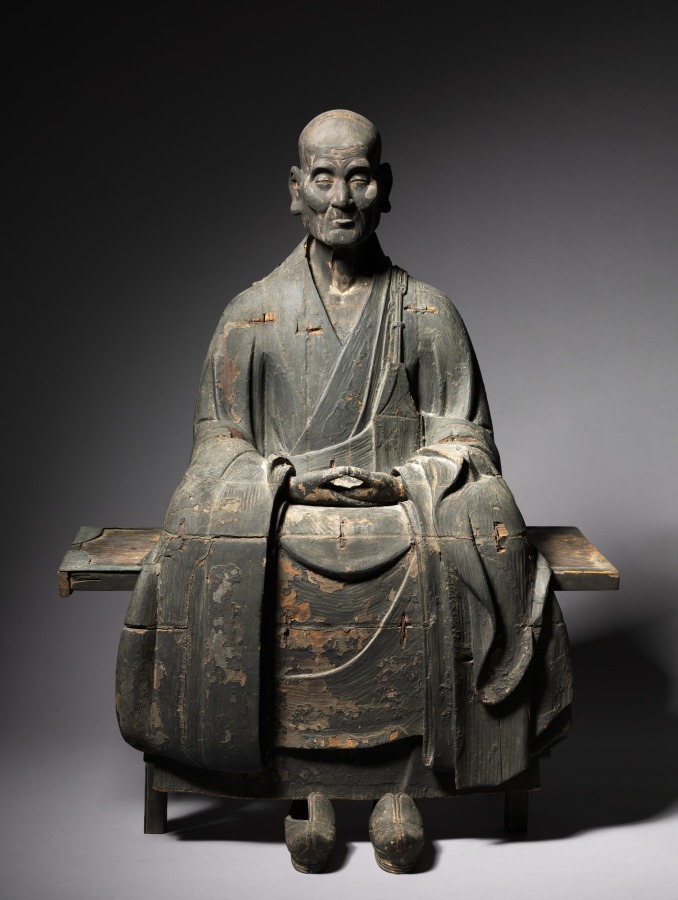
Portrait of Hottō Enmyō Kokushi (c. 1295–1315) is in the Cleveland Museum of Art collection.
The work and its context
The museum's open-access catalogue describes the work:
Hottō Enmyō Kokushi, is a posthumous title bestowed upon the Zen Buddhist monk Shinchi Kakushin (1203–1298) by the emperor Go-Daigo. The title means “perfectly awakened national teacher of the Dharma lamp.” Considered a fine example of “Kamakura realism,” while downplaying detail in the body, the sculpture emphasizes fidelity in representing the visage of Kakushin.
Object facts
- Title: Portrait of Hottō Enmyō Kokushi
- Date: c. 1295–1315
- Culture: Japan, Kamakura period (1185–1333)
- Type: Sculpture
- Technique: Hinoki cypress wood with lacquer, metal staples and fittings
- Dimensions: Overall: 91.4 cm (36 in.)
- Collection: Japanese Art
- Department: Japanese Art
- Accession number: 1970.67
A detail from the museum
Two famous sculptural portraits of this monk, one at the temple Ankokuji in Hiroshima, and another at the temple Kōkokuji in Wakayama, are dated to 1275 and 1286, respectively.
Collection credit
Leonard C. Hanna Jr. Fund
Further reading listed by the museum
- Kurata, Osamu 蔵田蔵 Kumano [熊野]. Tokyo: Kodansha, 1968.
- Lee, Sherman E. “The Year in Review for 1970.” The Bulletin of the Cleveland Museum of Art 58, no. 2 (February 1971): 22–71.
- Lee, Sherman E. “Zen in Art: Art in Zen.” The Bulletin of the Cleveland Museum of Art 59, no. 9 (November 1972): 239–259.
View the collection record
See the museum's photographs and full catalogue entry. Catalogue text is reproduced from the Cleveland Museum of Art's open-access data, with HTML formatting removed. This object and its supplied image are designated CC0.
Sources
More in Lifestyle
Keep reading