Portrait of Louis-Philippe, Duke of Orléans, later King of the French (1804): Art, History and Details
Portrait of Louis-Philippe, Duke of Orléans, later King of the French at the Cleveland Museum of Art: 1804, watercolor on ivory in a gold locket frame. Explore the work's context, creator attribution and collection history.
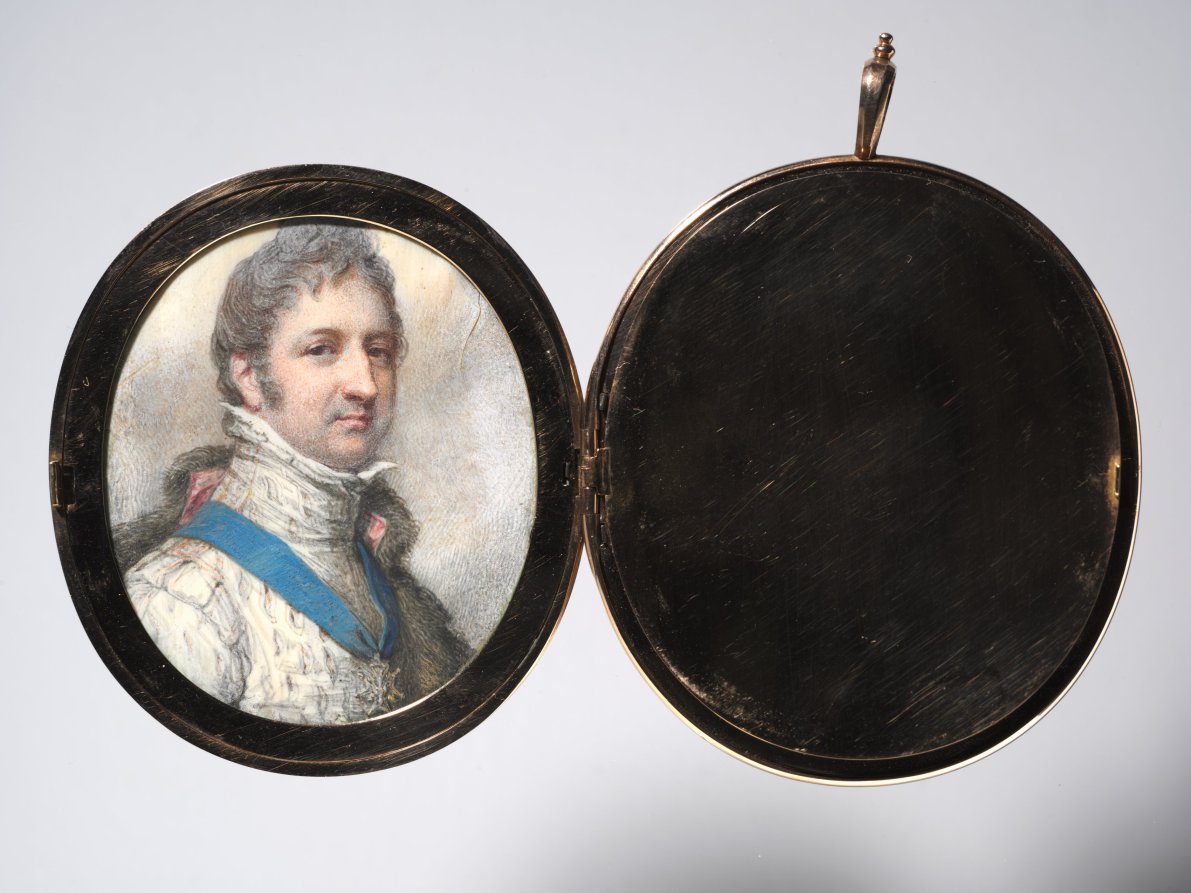
Portrait of Louis-Philippe, Duke of Orléans, later King of the French (1804) is in the Cleveland Museum of Art collection. The museum's creator attribution is Richard Cosway (British, 1742–1821).
The work and its context
The museum's open-access catalogue describes the work:
Louis-Philippe (1773–1850, king of the French 1830–48) was the son of Louis-Philippe Joseph, duc d’Orléans, who was known as Philippe-Egalité during the French Revolution. The Orléans family was a branch of the House of Bourbon. This work was painted while Louis-Philippe was in exile and living in England from 1800 until 1815, when Napoleon abdicated. He finally succeeded Charles X as king of France in 1830. During the February Revolution of 1848, Louis-Philippe was again forced into exile in England where he died two years later. Richard Cosway had painted Louis-Philippe (as well as his siblings and father) when the family was in England immediately following the outbreak of revolution in 1789. Louis-Philippe would have been thirty-one years old when this work was executed. He wears the Order of the Holy Spirit, a chivalric order of the French monarchy, which can be distinguished by its white dove surrounded by green flames at the center of a Maltese cross, with fleur-de-lis between the arms of the cross. Instead of the brilliant turquoise and white cloud background traditionally associated with Cosway, this miniature has the more restrained, gray, hatched background that characterizes the artist’s later works. The surface of the work is much marred by an irreversible crystallization of the paint layer that further emphasizes the gray tones throughout. The form of the unmarked case is typically English, but the motif is French, which may indicate a French goldsmith imitating the English style. The motif resembles a swan composed of foliate scrolls. A lock of plaited brown hair is also enclosed under glass within the locket, facing the miniature.
Object facts
- Title: Portrait of Louis-Philippe, Duke of Orléans, later King of the French
- Date: 1804
- Creator attribution: Richard Cosway (British, 1742–1821)
- Culture: England, early 19th Century
- Type: Portrait Miniature
- Technique: watercolor on ivory in a gold locket frame
- Dimensions: Framed: 7.5 x 6.6 cm (2 15/16 x 2 5/8 in.); Unframed: 6.3 x 5.4 cm (2 1/2 x 2 1/8 in.)
- Collection: Mod Euro - Painting 1800-1960
- Department: Modern European Painting and Sculpture
- Accession number: 1953.322
A detail from the museum
Without DNA analysis it is impossible to know to whom the hair belonged, though the most likely candidate is Louis-Philippe himself.
Collection credit
The Edward B. Greene Collection
Further reading listed by the museum
- Walker, R. J. B. The Eighteenth and Early Nineteenth Century Miniatures in the Collection of Her Majesty the Queen. Cambridge: Cambridge University Press, 1992.
- Cleveland Museum of Art, and Alan Chong. European & American Painting in the Cleveland Museum of Art: A Summary Catalogue. Cleveland, Ohio: Cleveland Museum of Art, 1993.
- Lloyd, Stephen, and Richard Cosway. Richard Cosway. London: Unicorn Press, 2005.
View the collection record
See the museum's photographs and full catalogue entry. Catalogue text is reproduced from the Cleveland Museum of Art's open-access data, with HTML formatting removed. This object and its supplied image are designated CC0.
Sources
More in Lifestyle
Keep reading