Portrait of Prince Murad Baksh (1624–1661) (c. 1655): Art, History and Details
Portrait of Prince Murad Baksh (1624–1661) at the Cleveland Museum of Art: c. 1655, Gum tempera and gold on paper. Explore the work's context, creator attribution and collection history.
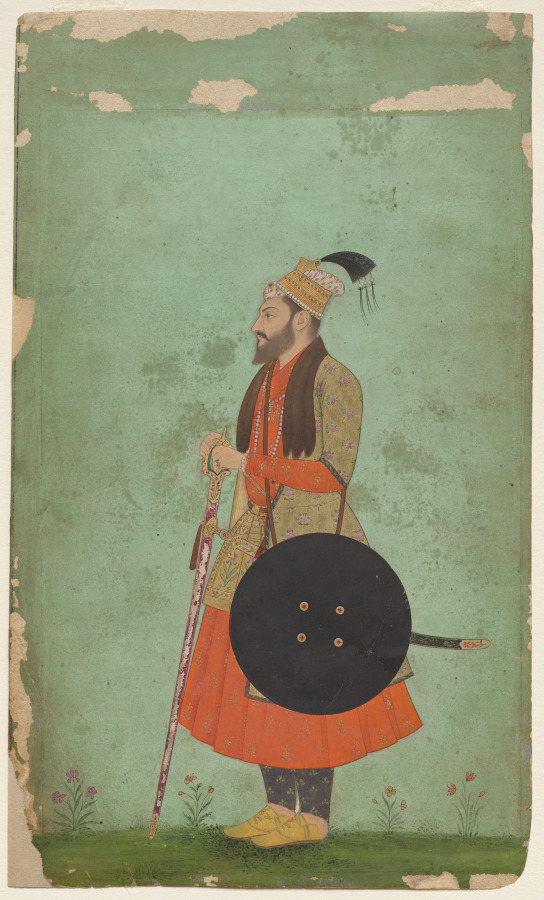
Portrait of Prince Murad Baksh (1624–1661) (c. 1655) is in the Cleveland Museum of Art collection.
The work and its context
The museum's open-access catalogue describes the work:
This portrait depicts the Mughal prince Murad Baksh in his early 30s, at the height of his power and promise. He wears a golden coat of honor with fur collar and the swords and shield of a military officer. As the youngest son of Emperor Shah Jahan, he was intimately involved in the struggles for succession. In 1658, he sided with his brother Aurangzeb (1618–1707) against their eldest brother, the crown prince, whom they defeated in a decisive battle that led to the crown prince’s eventual assassination in 1659. Aurangzeb then turned on his youngest brother, Murad Baksh himself, and had him imprisoned and finally executed in 1661.
Object facts
- Title: Portrait of Prince Murad Baksh (1624–1661)
- Date: c. 1655
- Culture: Mughal India, court of Shah Jahan (1627–58)
- Type: Painting
- Technique: Gum tempera and gold on paper
- Dimensions: Overall: 20 x 12 cm (7 7/8 x 4 3/4 in.)
- Collection: Indian Art
- Department: Indian and Southeast Asian Art
- Accession number: 1917.1066
Collection credit
Gift of the John Huntington Art and Polytechnic Trust
Further reading listed by the museum
- Leach, Linda York. Indian Miniature Paintings and Drawings. Cleveland, OH: Cleveland Museum of Art in cooperation with Indiana University Press, 1986.
View the collection record
See the museum's photographs and full catalogue entry. Catalogue text is reproduced from the Cleveland Museum of Art's open-access data, with HTML formatting removed. This object and its supplied image are designated CC0.
Sources
More in Lifestyle
Keep reading