Portrait of Raja Ram Singh of Amber (r. 1667-1688) with a Deccan Sword (recto); Calligraphy (verso) (c. 1680–1685): Art, History and Details
Portrait of Raja Ram Singh of Amber (r. 1667-1688) with a Deccan Sword (recto); Calligraphy (verso) at the Cleveland Museum of Art: c. 1680–1685, Gum tempera, ink, and gold on paper. Explore the work's context, creator attribution and colle
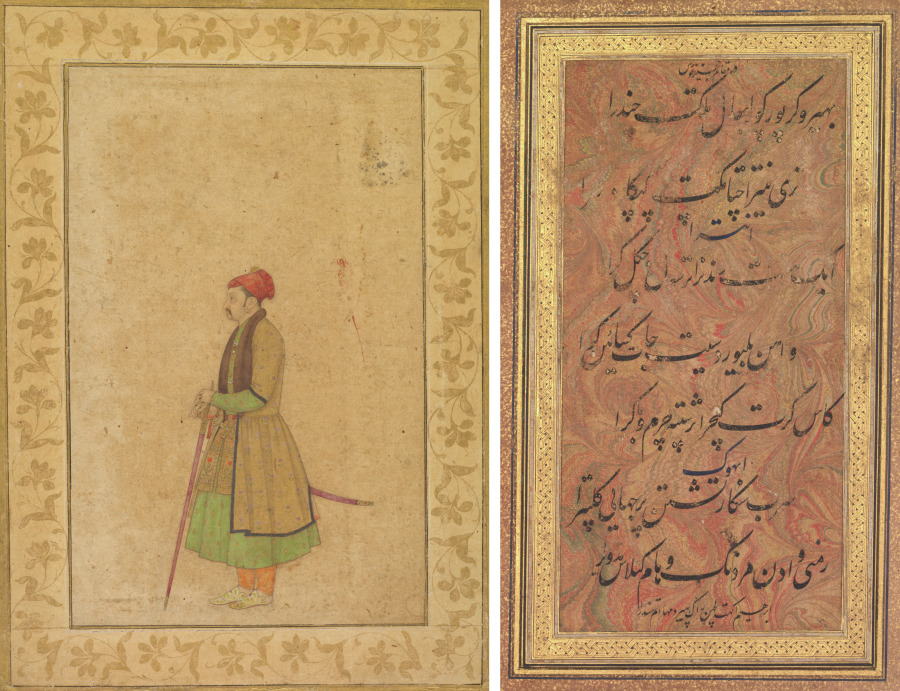
Portrait of Raja Ram Singh of Amber (r. 1667-1688) with a Deccan Sword (recto); Calligraphy (verso) (c. 1680–1685) is in the Cleveland Museum of Art collection.
The work and its context
The museum's open-access catalogue describes the work:
The sensitive, naturalistic rendering of weariness and forbearance in the face belies the trappings of favor bestowed on Ram Singh by the Mughal emperors Shah Jahan and Alamgir, whom he served as courtier and general between 1643 and 1688. He was a Hindu ruler from the kingdom of Amber in Rajasthan, under the control of the Mughal empire. Spending most of his life at the imperial court or leading military expeditions for the Mughals, this portrait was included in a Mughal album and inscribed with an Urdu verse indicating his value to the empire: "wherever he has led an expedition, victory is his." He wears a sumptuous coat of honor with a fur collar, woven with gold threads and floral sprigs and costly rubies, emeralds, and pearls. The straight sword with enameled hilt may be the one gifted to him by the emperor upon his succession to the throne as king of Amber in 1667. His long history of service at the imperial court, however, was checkered with troubles, including his allegiances with failed successors of Shah Jahan and the escape of the rebel Shivaji under his watch.
Object facts
- Title: Portrait of Raja Ram Singh of Amber (r. 1667-1688) with a Deccan Sword (recto); Calligraphy (verso)
- Date: c. 1680–1685
- Culture: India, Mughal court, 17th century
- Type: Painting
- Technique: Gum tempera, ink, and gold on paper
- Dimensions: Page: 30.4 x 18.5 cm (11 15/16 x 7 5/16 in.)
- Collection: Indian Art - Mughal
- Department: Indian and Southeast Asian Art
- Accession number: 2013.330
Collection credit
Gift in honor of Madeline Neves Clapp; Gift of Mrs. Henry White Cannon by exchange; Bequest of Louise T. Cooper; Leonard C. Hanna Jr. Fund; From the Catherine and Ralph Benkaim Collection
Further reading listed by the museum
- Mace, Sonya Rhie, Mohsen Ashtiany, Catherine Glynn, Pedro Moura Carvalho, Marcus Fraser, and Ruby Lal. Mughal Paintings: Art and Stories: the Cleveland Museum of Art. London: D Giles Limited, 2016.
- Branfoot, Crispin, ed. Portraiture in South Asia Since the Mughals: Art, Representation and History. London; New York: I.B. Tauris & Co. Ltd., 2018.
View the collection record
See the museum's photographs and full catalogue entry. Catalogue text is reproduced from the Cleveland Museum of Art's open-access data, with HTML formatting removed. This object and its supplied image are designated CC0.
Sources
More in Lifestyle
Keep reading