Portrait of Sardar Singh (Son of Savant Singh, 1730–68) (c. 1760): Art, History and Details
Portrait of Sardar Singh (Son of Savant Singh, 1730–68) at the Cleveland Museum of Art: c. 1760, Gum tempera and gold on paper. Explore the work's context, creator attribution and collection history.
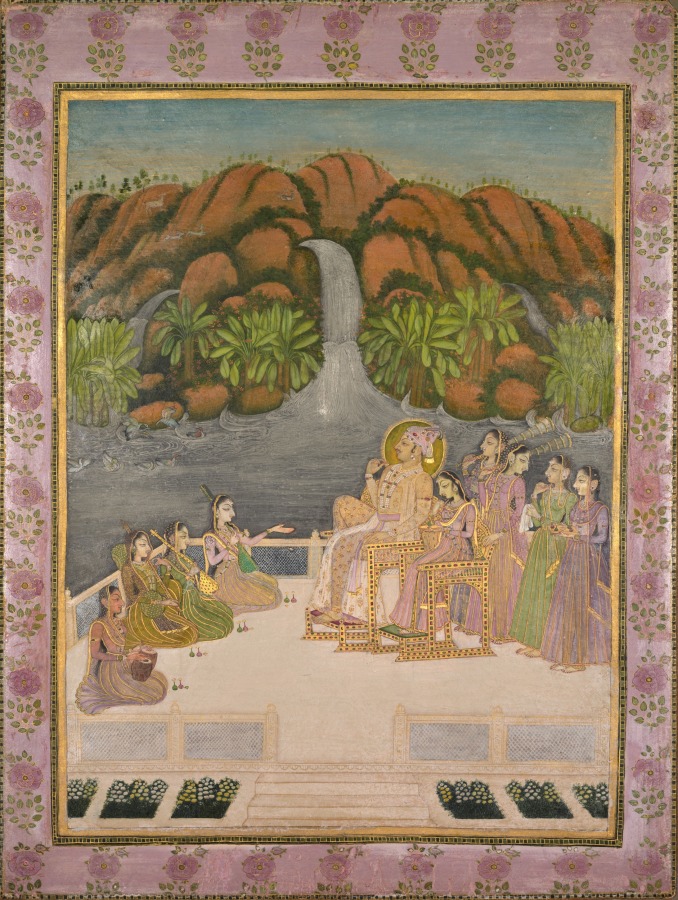
Portrait of Sardar Singh (Son of Savant Singh, 1730–68) (c. 1760) is in the Cleveland Museum of Art collection.
The work and its context
The museum's open-access catalogue describes the work:
The ruler of the princely state of Kishangarh chose to have himself depicted in an intoxicatingly paradisiacal setting. He and his queen occupy jeweled chairs on a white marble terrace with formal flower gardens overlooking a lake. They listen to a musical performance while female attendants stand ready to whisk away flies and serve tiny bottles liquor. The fresh palette and dramatically elongated eyes, especially on the women, are hallmarks of the most celebrated works from this Rajput court. The king is portrayed with less exaggerated features than the women, which makes him seem more human, despite the halo that sets off his face and elaborate turban.
Object facts
- Title: Portrait of Sardar Singh (Son of Savant Singh, 1730–68)
- Date: c. 1760
- Culture: Northwestern India, Rajasthan, Kishangarh
- Type: Painting
- Technique: Gum tempera and gold on paper
- Dimensions: Image: 27.9 x 21.9 cm (11 x 8 5/8 in.); Overall: 34.6 x 26.6 cm (13 5/8 x 10 1/2 in.)
- Collection: Indian Art
- Department: Indian and Southeast Asian Art
- Accession number: 2001.122
A detail from the museum
The ducks, rabbits, and deer in the landscape are in pairs, contributing to the amorous mood.
Collection credit
Edwin R. and Harriet Pelton Perkins Memorial Fund
Further reading listed by the museum
- Pauwels, Heidi Rika Maria. Mobilizing Krishna's World: The Writings of Prince Sāvant Singh of Kishangarh. Seattle: University of Washington Press, 2017.
View the collection record
See the museum's photographs and full catalogue entry. Catalogue text is reproduced from the Cleveland Museum of Art's open-access data, with HTML formatting removed. This object and its supplied image are designated CC0.
Sources
More in Lifestyle
Keep reading