Potter Seated with Double Gourd Vase (1300s): Art, History and Details
Potter Seated with Double Gourd Vase at the Cleveland Museum of Art: 1300s, Porcelain with underglaze decoration, qingbai ("blue-white") ware. Explore the work's context, creator attribution and collection history.
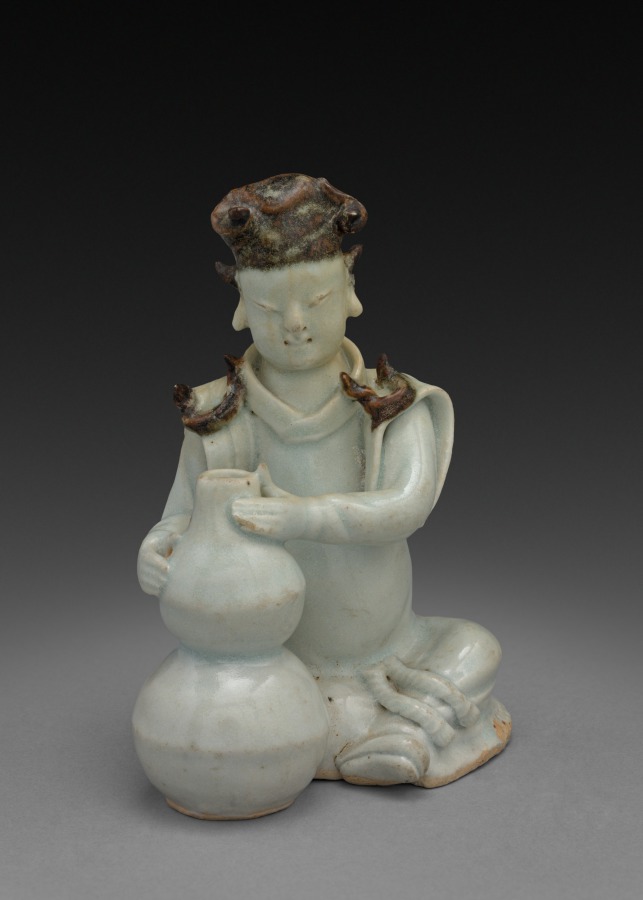
Potter Seated with Double Gourd Vase (1300s) is in the Cleveland Museum of Art collection.
The work and its context
The museum's open-access catalogue describes the work:
Made in South China, this figurine of a potter holding a double-gourd vase was probably once used as a toy. The coarse white porcelain form is covered with thin light greenish-blue, qingbai, glaze. The potter's cap and the coils on his shoulders are painted with blackish-brown ferruginous slip. The glaze stops short of the slightly recessed base, which is burnt a very light pinkish-buff color.
Object facts
- Title: Potter Seated with Double Gourd Vase
- Date: 1300s
- Culture: China, Yuan dynasty (1271-1368) - Ming dynasty (1368-1644)
- Type: Ceramic
- Technique: Porcelain with underglaze decoration, qingbai ("blue-white") ware
- Dimensions: Overall: 13.5 cm (5 5/16 in.)
- Collection: China - Yuan Dynasty
- Department: Chinese Art
- Accession number: 1973.14
A detail from the museum
The double gourd is traditionally regarded as a talisman that protected children against diseases.
Collection credit
The Severance and Greta Millikin Purchase Fund
Further reading listed by the museum
- Lee, Sherman E. The Colors of Ink: Chinese Paintings and Related Ceramics from the Cleveland Museum of Art. [New York]: Asia Society; distributed by New York Graphic Society, 1974.
- “The Year in Review for 1973.” The Bulletin of the Cleveland Museum of Art, vol. 61, no. 2, 1974, pp. 31–78.
View the collection record
See the museum's photographs and full catalogue entry. Catalogue text is reproduced from the Cleveland Museum of Art's open-access data, with HTML formatting removed. This object and its supplied image are designated CC0.
Sources
More in Lifestyle
Keep reading