Powder Flask (c. 1580): Art, History and Details
Powder Flask at the Cleveland Museum of Art: c. 1580, staghorn (two branches) carved with relief, scene of David and Bathsheba; iron suspension loop; mounts missing. Explore the work's context, creator attribution and collection history.
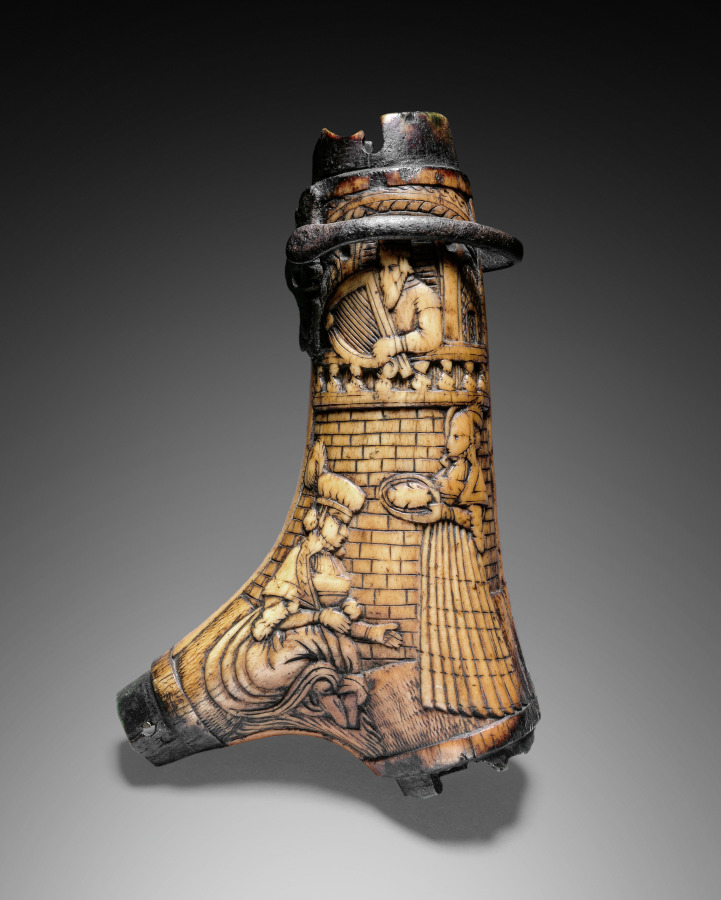
Powder Flask (c. 1580) is in the Cleveland Museum of Art collection.
The work and its context
The museum's open-access catalogue describes the work:
Powder flasks are small, portable containers designed to hold gunpowder. From the 1400s to the 1800s, powder flasks were indispensable for charging and priming firearms of all types. Without powder flasks firearms were of little use to their owners. Many highly decorated flasks rank as works of art. During the 1500s, they were frequently decorated with images of famous historical figures. Here the figures of King David and Bathsheba derive from the Old Testament.
Object facts
- Title: Powder Flask
- Date: c. 1580
- Culture: Germany, late 16th Century
- Type: Arms and Armor
- Technique: staghorn (two branches) carved with relief, scene of David and Bathsheba; iron suspension loop; mounts missing
- Dimensions: Overall: 16.9 x 11.1 cm (6 5/8 x 4 3/8 in.)
- Collection: MED - Arms & Armor
- Department: Medieval Art
- Accession number: 1916.1906
Collection credit
Gift of Mr. and Mrs. John L. Severance
Further reading listed by the museum
- Gilchrist, Helen Ives. A Catalogue of the Collection of Arms & Armor Presented to the Cleveland Museum of Art by Mr. and Mrs. John Long Severance; 1916-1923. Cleveland: The Cleveland Museum of Art, 1924.
View the collection record
See the museum's photographs and full catalogue entry. Catalogue text is reproduced from the Cleveland Museum of Art's open-access data, with HTML formatting removed. This object and its supplied image are designated CC0.
Sources
More in Lifestyle
Keep reading