Powder horn (1600s-1700s): Art, History and Details
Powder horn at the Cleveland Museum of Art: 1600s-1700s, Jadeite, iron inlaid with brass. Explore the work's context, creator attribution and collection history.
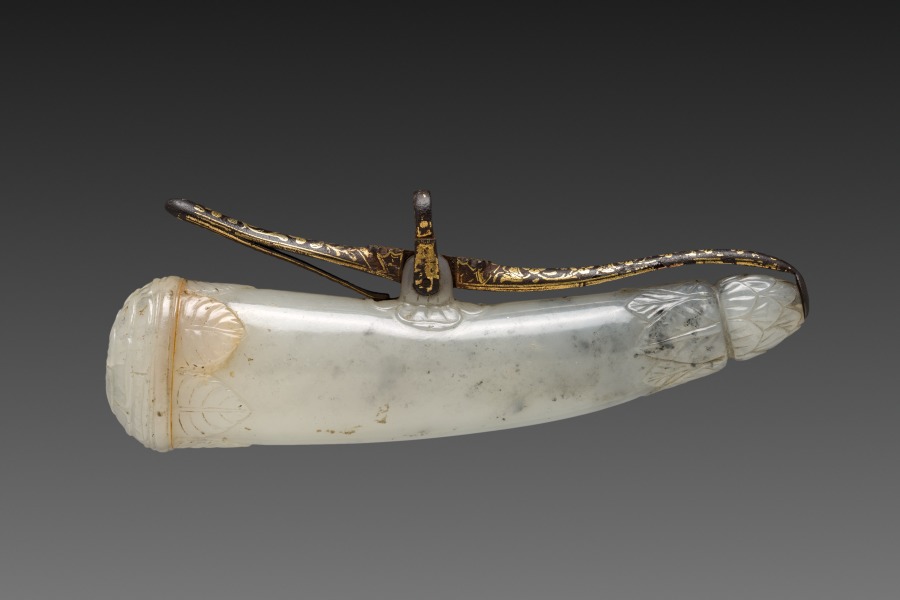
Powder horn (1600s-1700s) is in the Cleveland Museum of Art collection.
The work and its context
The museum's open-access catalogue describes the work:
Like the firearms themselves, powder horns were made as courtly accessories to be worn as objects of beauty. Most Mughal nobles also served as military commanders, and accouterments of war would be worn as part of their formal attire. For this reason, artisans used precious materials such as white jade, which in this example has been carved with leaf and petal patterns, its natural black inclusions treated as ornament. Pressing down on the simple mechanism opens the hollow inner chamber from which small amounts of gunpowder were administered into the pan of a matchlock musket.
Object facts
- Title: Powder horn
- Date: 1600s-1700s
- Culture: India, Mughal, 17th-18th century
- Type: Jade
- Technique: Jadeite, iron inlaid with brass
- Dimensions: Overall: 12 cm (4 3/4 in.)
- Collection: Indian Art
- Department: Indian and Southeast Asian Art
- Accession number: 1989.351
A detail from the museum
White jade came from the Khotan region of Central Asia, in what is now China.
Collection credit
Bequest of Mrs. Severance A. Millikin
View the collection record
See the museum's photographs and full catalogue entry. Catalogue text is reproduced from the Cleveland Museum of Art's open-access data, with HTML formatting removed. This object and its supplied image are designated CC0.
Sources
More in Lifestyle
Keep reading
Related stories