Pradyumna and Samvara fight with maces, from the "Large Basohli Bhagavata Purana" (c. 1760–65): Art, History and Details
Pradyumna and Samvara fight with maces, from the "Large Basohli Bhagavata Purana" at the Cleveland Museum of Art: c. 1760–65, Gum tempera, ink, and gold on paper. Explore the work's context, creator attribution and collection history.
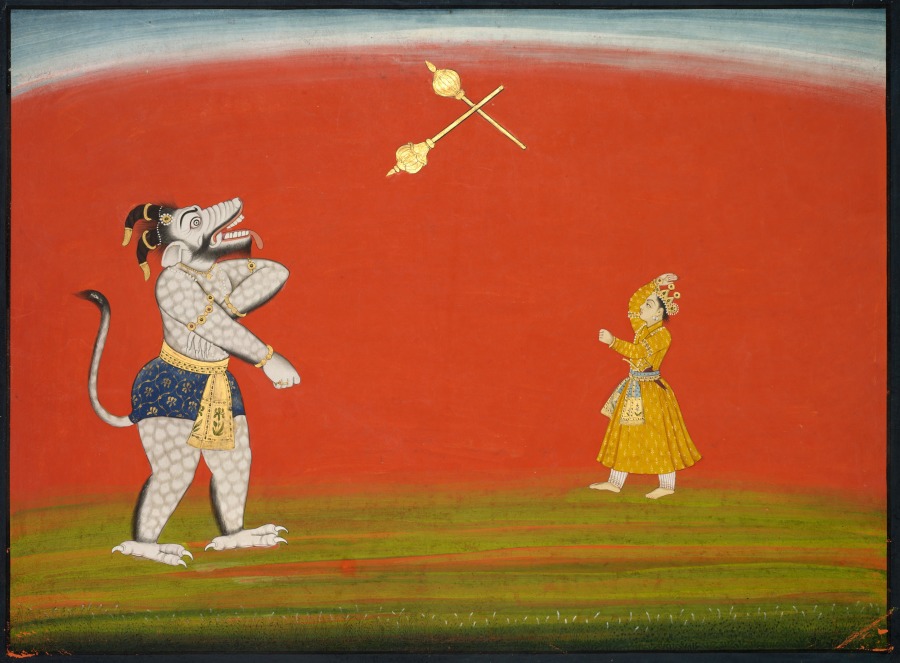
Pradyumna and Samvara fight with maces, from the "Large Basohli Bhagavata Purana" (c. 1760–65) is in the Cleveland Museum of Art collection.
The work and its context
The museum's open-access catalogue describes the work:
Paintings from this Pahari series often place figures against boldly contrasting backgrounds. Here, the scene that takes place a moment before the prince Pradyumna’s mace, or club, vanquishes the demon Samvara is frozen in time. Years before, the demon heard a prophecy that Pradyumna would one day murder him. Hearing this, Samvara kidnapped Pradyumna as an infant and threw him into the ocean, where a fish swallowed him. The fish was caught and brought to Samvara’s kitchen, where the woman who would become his wife, Mayavati, discovered the baby still alive in its belly. Pradyumna lived to fulfill the prophecy, eventually killing the demon in this fight.
Object facts
- Title: Pradyumna and Samvara fight with maces, from the "Large Basohli Bhagavata Purana"
- Date: c. 1760–65
- Culture: Northern India, Pahari kingdoms
- Type: Painting
- Technique: Gum tempera, ink, and gold on paper
- Dimensions: Image: 28 x 38.3 cm (11 x 15 1/16 in.); Overall: 30.2 x 41 cm (11 7/8 x 16 1/8 in.)
- Collection: Indian Art
- Department: Indian and Southeast Asian Art
- Accession number: 1960.184
A detail from the museum
Pradyumna is the incarnation (avatar) of Kama, the god of erotic love.
Collection credit
Gift of the Mundane Club
Further reading listed by the museum
- Leach, Linda York. Indian Miniature Paintings and Drawings. Cleveland, OH: Cleveland Museum of Art in cooperation with Indiana University Press, 1986.
View the collection record
See the museum's photographs and full catalogue entry. Catalogue text is reproduced from the Cleveland Museum of Art's open-access data, with HTML formatting removed. This object and its supplied image are designated CC0.
Sources
More in Lifestyle
Keep reading