Pricket Candlestick (early 1500s): Art, History and Details
Pricket Candlestick at the Cleveland Museum of Art: early 1500s, brass (hollow cast in three parts) and iron. Explore the work's context, creator attribution and collection history.
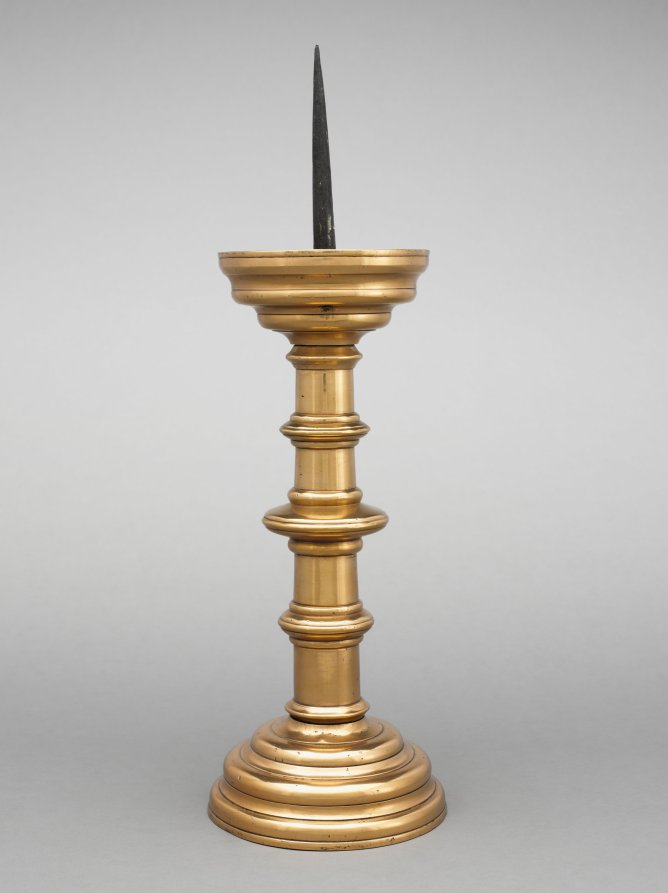
Pricket Candlestick (early 1500s) is in the Cleveland Museum of Art collection.
The work and its context
The museum's open-access catalogue describes the work:
This object is an example of a type of metalwork known as "dinanderie," produced in and around the town of Dinant on the River Meuse in the Belgian province of Namur. Late medieval Dinant specialized in the production of these finely cast and finished objects in brass alloy, supplying aquamanilia, candlesticks, patens, basins, baptismal fonts, and other altar furniture throughout the Meuse Valley and for export beyond.
Object facts
- Title: Pricket Candlestick
- Date: early 1500s
- Culture: South Netherlands, Valley of the Meuse, 16th century
- Type: Metalwork
- Technique: brass (hollow cast in three parts) and iron
- Dimensions: Overall: 45.5 x 19.6 cm (17 15/16 x 7 11/16 in.)
- Collection: MED - Renaissance
- Department: Medieval Art
- Accession number: 1974.185
Collection credit
Gift of Dr. and Mrs. Paul G. Ecker
Further reading listed by the museum
- Lee, Sherman E. “The Year in Review for 1974.” The Bulletin of the Cleveland Museum of Art 62, no. 3 (March 1975): 62–102.
View the collection record
See the museum's photographs and full catalogue entry. Catalogue text is reproduced from the Cleveland Museum of Art's open-access data, with HTML formatting removed. This object and its supplied image are designated CC0.
Sources
More in Lifestyle
Keep reading