Prince Shreyamsa dreams of the coming of Rishabha, from a Panchakalyanaka (Five Auspicious Events) (1670–80): Art, History and Details
Prince Shreyamsa dreams of the coming of Rishabha, from a Panchakalyanaka (Five Auspicious Events) at the Cleveland Museum of Art: 1670–80, Gum tempera, ink, silver, and gold on paper. Explore the work's context, creator attribution and col
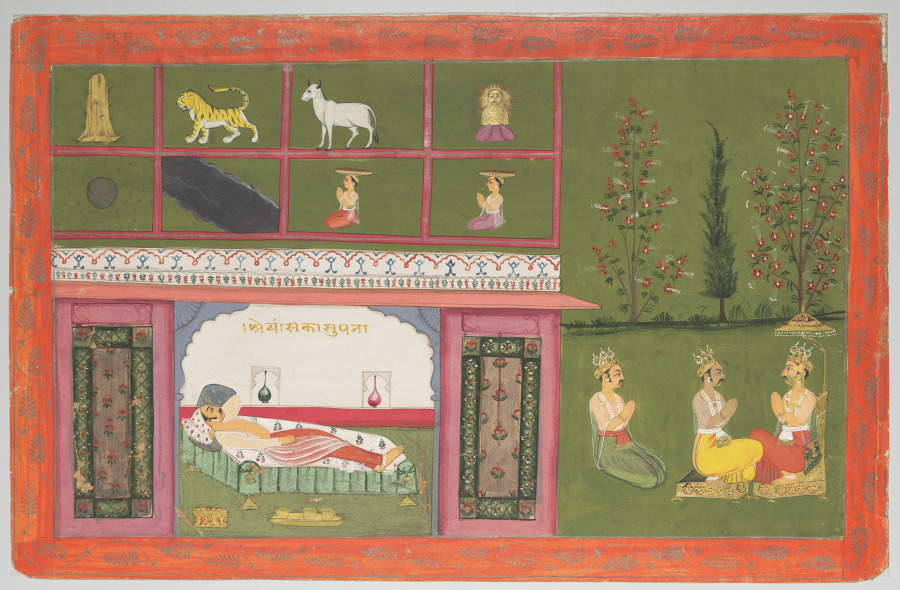
Prince Shreyamsa dreams of the coming of Rishabha, from a Panchakalyanaka (Five Auspicious Events) (1670–80) is in the Cleveland Museum of Art collection.
The work and its context
The museum's open-access catalogue describes the work:
Dreams foretell important events in Indian literature. In this painting a prince lies half asleep and experiences eight visions, pictured above the reclining figure. At the right, the prince on the throne with the royal umbrella seeks help interpreting the dreams. They predicted the coming of Rishabha, the first Jina, who has been fasting for a full year. The prince then became the first person in the world to give proper alms, or pious offerings, to a Jina. This painting is from a group that is recognized as the first Jain manuscript made in the form of a pictorial series, rather than a handwritten manuscript.
Object facts
- Title: Prince Shreyamsa dreams of the coming of Rishabha, from a Panchakalyanaka (Five Auspicious Events)
- Date: 1670–80
- Culture: Northwestern India, Rajasthan, Rajput Kingdom of Amber
- Type: Painting
- Technique: Gum tempera, ink, silver, and gold on paper
- Dimensions: 26.7 x 42.5 cm (10 1/2 x 16 3/4 in.)
- Collection: Indian Art
- Department: Indian and Southeast Asian Art
- Accession number: 2021.12
A detail from the museum
This painting is from the earliest known Jain series made in a Mughal-inspired style.
Collection credit
Jo Hershey Selden Fund
View the collection record
See the museum's photographs and full catalogue entry. Catalogue text is reproduced from the Cleveland Museum of Art's open-access data, with HTML formatting removed. This object and its supplied image are designated CC0.
Sources
More in Lifestyle
Keep reading


