Print of Xu Gate and the City Moat (1736–95): Art, History and Details
Print of Xu Gate and the City Moat at the Cleveland Museum of Art: 1736–95, Multicolor woodblock print; ink and color on paper, printed in black, later hand colored, possibly in Europe. Explore the work's context, creator attribution and co
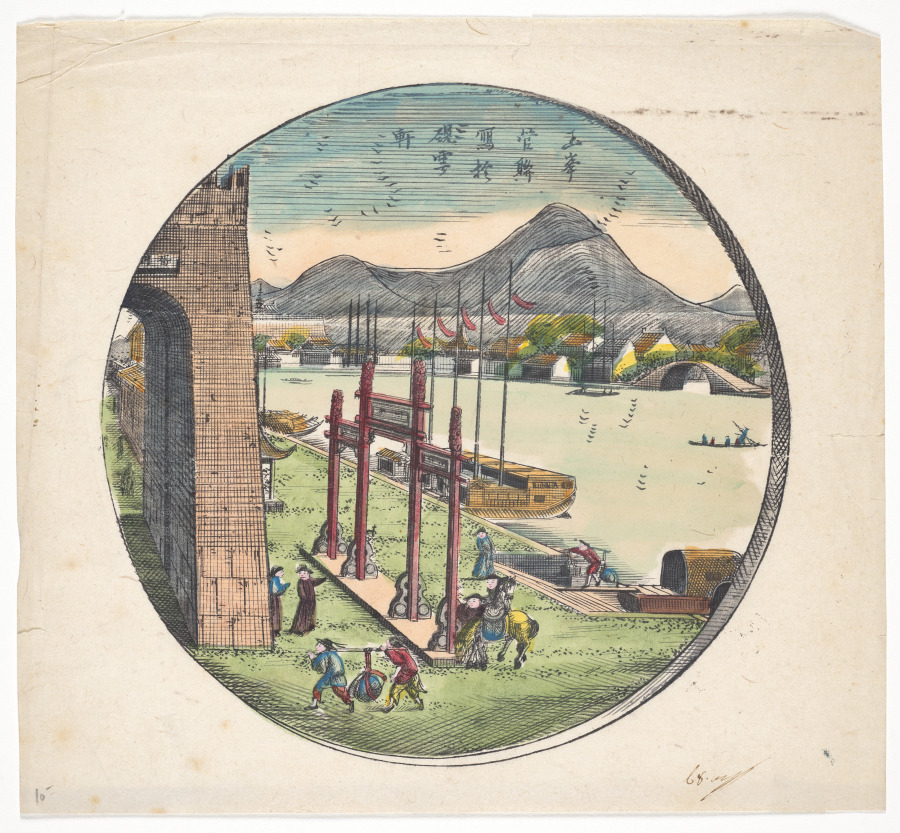
Print of Xu Gate and the City Moat (1736–95) is in the Cleveland Museum of Art collection.
The work and its context
The museum's open-access catalogue describes the work:
Designed with an innovative perspective, as if the viewer is looking at the scenes through a camera lens, this round print shows the scenery and arch of Xu Gate, part of the city wall, in the west of Suzhou. The location was traditionally frequented at the lantern festival during New Year celebrations in early spring. The print thus combined multiple selling points: it could be sold to locals as New Year prints, as souvenirs to tourists, and as curious images of China to agents from overseas.
Object facts
- Title: Print of Xu Gate and the City Moat
- Date: 1736–95
- Culture: Southeast China, Suzhou, Qing dynasty (1644–1911), Qianlong reign (1736–95)
- Type: Print
- Technique: Multicolor woodblock print; ink and color on paper, printed in black, later hand colored, possibly in Europe
- Dimensions: Diameter: 24.3 cm (9 9/16 in.); Sheet: 27.4 x 30.2 cm (10 13/16 x 11 7/8 in.)
- Collection: China - Qing Dynasty
- Department: Chinese Art
- Accession number: 2025.86
A detail from the museum
Woodblock printing in color reached a height in China in the 1600s to 1700s. The prints were executed by means of sets o separate blocks, each carved to print a different color.
Collection credit
Purchase from the J. H. Wade Fund
View the collection record
See the museum's photographs and full catalogue entry. Catalogue text is reproduced from the Cleveland Museum of Art's open-access data, with HTML formatting removed. This object and its supplied image are designated CC0.
Sources
More in Lifestyle
Keep reading