Prisoners on a Projecting Platform, Plate 10 (1749–50): Art, History and Details
Prisoners on a Projecting Platform, Plate 10 at the Cleveland Museum of Art: 1749–50, etching, engraving, sulphur tint or open bite, burnishing. Explore the work's context, creator attribution and collection history.
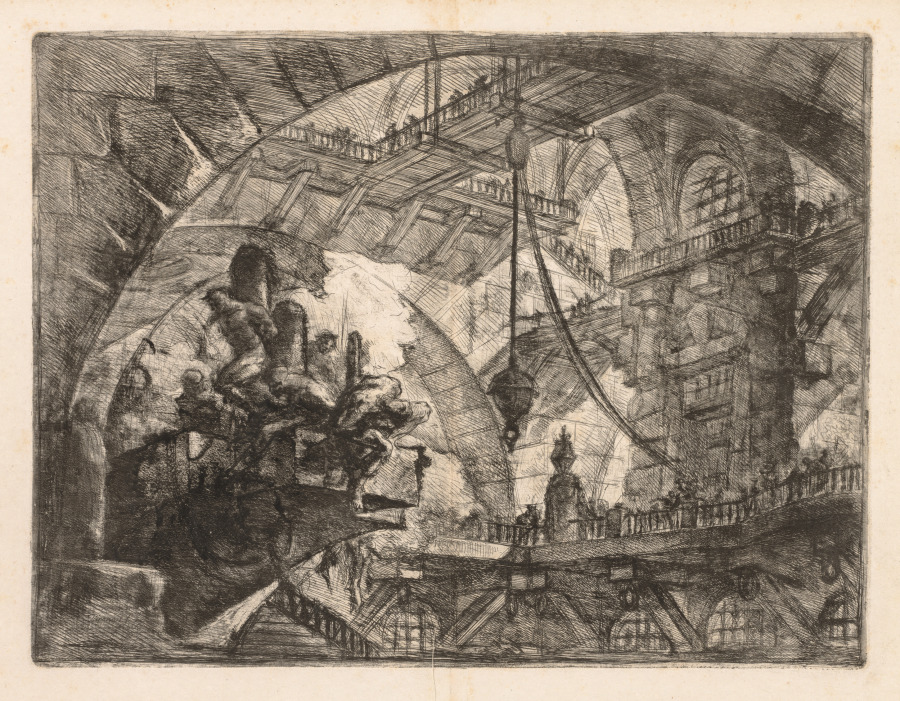
Prisoners on a Projecting Platform, Plate 10 (1749–50) is in the Cleveland Museum of Art collection. The museum's creator attribution is Giovanni Battista Piranesi (Italian, 1720–1778).
The work and its context
The museum's open-access catalogue describes the work:
In his series of imaginary prisons, Giovanni Battista Piranesi experimented with scale, perspective, and etching to create disorienting and disturbing images of incarceration. Based on his training as a stage designer rather than on observations of real prisons, Piranesi used a low vantage point and distant staircases to disrupt traditional perspective and to emphasize both the monumentality of the space and the futility of trying to escape. Set against a strange cloud of white smoke, the densely drawn and deeply etched lines of the prisoners at left produce a confusing jumble of bodies that, while imprecise, evoke their pain and punishment.
Object facts
- Title: Prisoners on a Projecting Platform, Plate 10
- Date: 1749–50
- Creator attribution: Giovanni Battista Piranesi (Italian, 1720–1778)
- Culture: Italy
- Type: Print
- Technique: etching, engraving, sulphur tint or open bite, burnishing
- Dimensions: Plate: 41.2 x 54.2 cm (16 1/4 x 21 5/16 in.); Sheet: 49.5 x 63.4 cm (19 1/2 x 24 15/16 in.)
- Collection: PR - Etching
- Department: Prints
- Accession number: 1941.26.8
A detail from the museum
Author Thomas De Quincy compared the disorienting and disturbing imagery of this series to his experience with opium addiction in his 1821 book Confessions of an English Opium-Eater.
Collection credit
Dudley P. Allen Fund
View the collection record
See the museum's photographs and full catalogue entry. Catalogue text is reproduced from the Cleveland Museum of Art's open-access data, with HTML formatting removed. This object and its supplied image are designated CC0.
Sources
More in Lifestyle
Keep reading