Procession of Nobles (100–150 CE): Art, History and Details
Procession of Nobles at the Cleveland Museum of Art: 100–150 CE, limestone. Explore the work's context, creator attribution and collection history.
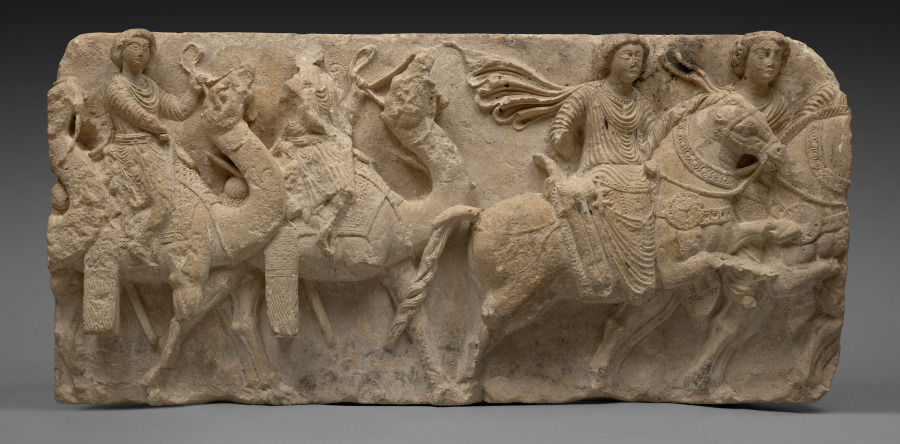
Procession of Nobles (100–150 CE) is in the Cleveland Museum of Art collection.
The work and its context
The museum's open-access catalogue describes the work:
Palmyra was a key center for trade between the Roman and Parthian Empires. This unique relief has been associated with Palmyra only through stylistic comparisons; it is not known where it was found on the site. It depicts men in Parthian dress riding Arabian horses with bejeweled harness trappings ahead of riders on camels—a possible reference to the caravans that made Palmyra so wealthy. Although all of the riders are dressed and equipped as Parthians, the proportions and perspective of the scene seem to be informed by Greco-Roman conventions. It may depict a ceremonial procession.
Object facts
- Title: Procession of Nobles
- Date: 100–150 CE
- Culture: Syria, Palmyra
- Type: Sculpture
- Technique: limestone
- Dimensions: Overall: 57.7 x 120.7 x 34.5 cm (22 11/16 x 47 1/2 x 13 9/16 in.)
- Collection: Near Eastern Art
- Department: Egyptian and Ancient Near Eastern Art
- Accession number: 1970.15
Collection credit
Purchase from the J. H. Wade Fund
Further reading listed by the museum
- Lee, Sherman E. “The Year in Review for 1970.” The Bulletin of the Cleveland Museum of Art 58, no. 2 (1971): 22–71.
- Kozloff, Arielle P. “Three Ancient near Eastern Celebrations and a Guest of Honor.” The Bulletin of the Cleveland Museum of Art 61, no. 1 (1974): 14–26.
- The Cleveland Museum of Art. Handbook of the Cleveland Museum of Art/1978. Cleveland, OH: The Cleveland Museum of Art, 1978.
View the collection record
See the museum's photographs and full catalogue entry. Catalogue text is reproduced from the Cleveland Museum of Art's open-access data, with HTML formatting removed. This object and its supplied image are designated CC0.
Sources
More in Lifestyle
Keep reading